

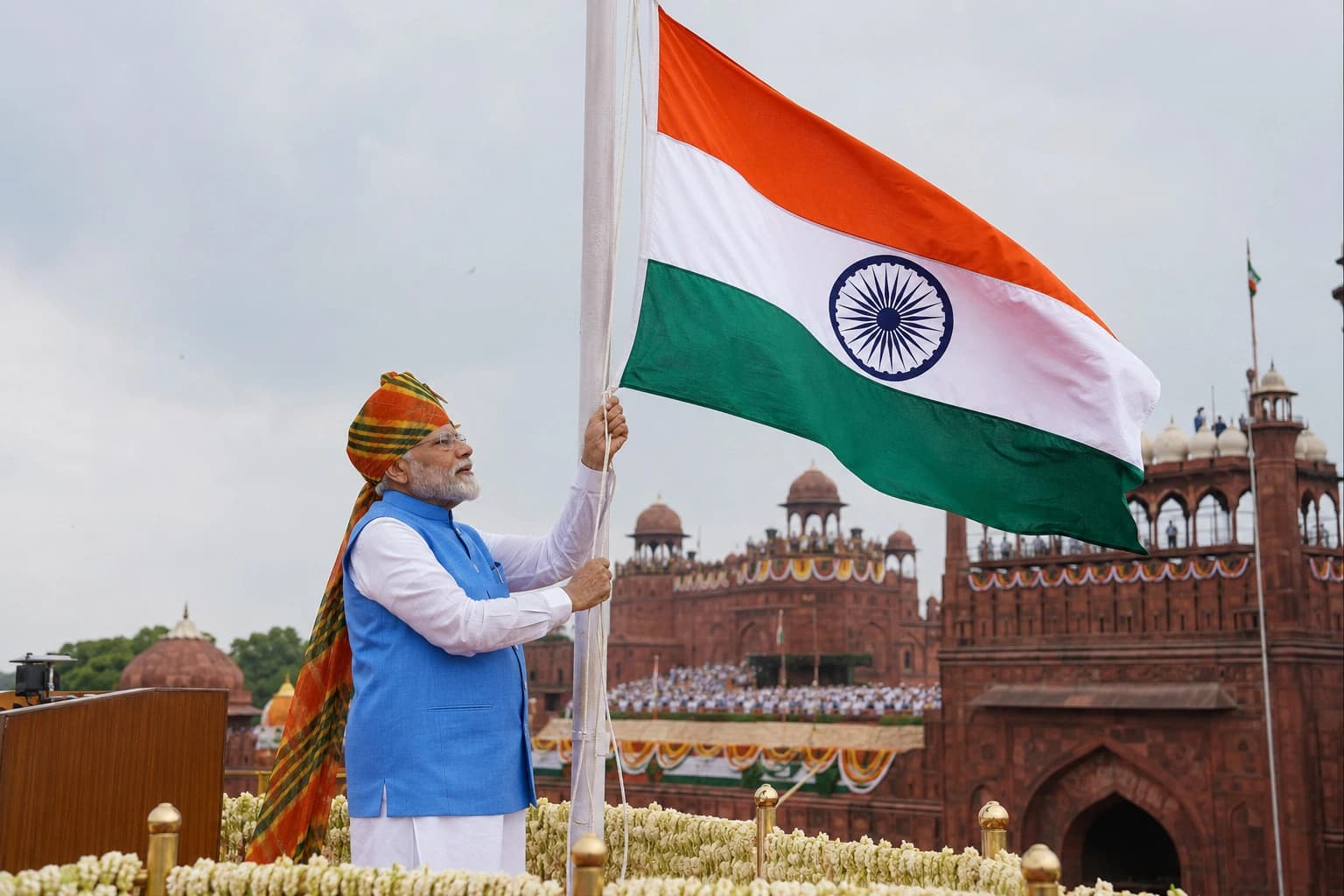
India will celebrate its 80th Independence Day on Saturday, 15 August 2026. That is not a contradiction of the number 79: 79 full years have passed since 15 August 1947, and the 80th ceremony is being held because 1947 itself counts as the first Independence Day. The official themes, announced by the Ministry of Defence, are 150 Years of Vande Mataram and Yuva Shakti for Viksit Bharat@2047. For the first time, the National Song will be sung from the ramparts of the Red Fort when the Prime Minister arrives, before the flag is unfurled and Jana Gana Mana is played.
This explainer answers the questions people are actually searching today: 79th or 80th, what the 2026 theme means, why Vande Mataram is entering the Red Fort sequence, what happens during the ceremony, and why Pakistan’s Independence Day falls on 14 August.
Is 2026 the 79th or the 80th Independence Day?
Subtract 1947 from 2026 and you get 79. That arithmetic is correct for years of independence. It is the wrong way to count Independence Days.
India’s first Independence Day was 15 August 1947. The second was 15 August 1948, and so on. Count inclusively from 1947 and 2026 is the 80th occasion.
15 August 1947: 1st Independence Day; freedom begins.
15 August 1948: 2nd Independence Day; 1 year of independence.
15 August 2026: 80th Independence Day; 79 years since 1947.
The Press Information Bureau’s Defence Ministry release of 10 August 2026 states it plainly: the nation will mark its 80th Independence Day on 15 August 2026. Schools, offices, and news crawls that say “79th” are counting years elapsed, not ceremonies held.
What is the Independence Day 2026 theme?
There are two official themes, not one.
1. 150 Years of Vande Mataram
Bankim Chandra Chattopadhyay wrote Vande Mataram in 1876. It later appeared in his novel Anandamath (1882). Rabindranath Tagore sang it at the 1896 Calcutta session of the Indian National Congress. The Constituent Assembly adopted it as India’s National Song (distinct from the National Anthem, Jana Gana Mana). 2026 is the 150th year of the composition. The government is treating that anniversary as a centrepiece of the Red Fort ceremony.
2. Yuva Shakti for Viksit Bharat@2047
This points forward, not back. Viksit Bharat@2047 is the stated goal of a developed India by the 100th year of independence. “Yuva Shakti” is the government’s label for the role of young Indians in that project. Defence Secretary Rajesh Kumar Singh told reporters the theme was planned from mid-June and was not a response to the Jantar Mantar student protests. Treat that as the official line; the ceremony still puts students, Olympiad medalists, interns, and young workers on the rampart and in the guest list.
Together the two themes do one job: connect the freedom movement’s song to a 2047 development slogan, with Gen Z visibly in the frame.
Why will Vande Mataram be sung at Red Fort for the first time?
Until this year, the Red Fort sequence after the Prime Minister’s arrival has been built around the flag and the National Anthem. The National Song was not part of that official rampart protocol.
In 2026 it is. According to the Defence Ministry (PIB, 10 August 2026) and the Defence Secretary’s briefing:
The Prime Minister arrives on the rampart.
Vande Mataram is sung. Invitees remain standing.
The Prime Minister unfurls the National Flag.
Jana Gana Mana is played.
The Prime Minister addresses the nation.
That is a protocol change, not a replacement of the anthem. Vande Mataram comes before the flag; the anthem still follows the unfurling.
Visuals are built around the same anniversary:
About 2,500 NCC cadets and My Bharat volunteers will form वंदे मातरम् on Gyanpath, opposite the rampart.
An IAF Mi-17 will fly a banner marking 150 years of Vande Mataram and shower flower petals.
Floral decoration at the venue is themed on the song.
Military and CAPF bands have been performing Vande Mataram at 343 locations nationwide from 8 August through 15 August. Entry to those band events is open to the public.
If you are writing or teaching this: do not call Vande Mataram the National Anthem. The anthem is Jana Gana Mana. Vande Mataram is the National Song. Both have standing protocol; only the Red Fort order is new.
What happens at Red Fort on 15 August?
The Red Fort ceremony is the national broadcast event. The rest of the country follows with flag-hoisting at Raj Bhavans, collectorates, schools, and housing societies.
Typical sequence (2026 overlay in italics):
Early morning: the Prime Minister arrives at the Red Fort. Union ministers and officials are already there.
Vande Mataram is performed; the assembly stands.
The Prime Minister unfurls the Tricolour.
The National Anthem is played; a 21-gun salute is fired.
The Prime Minister addresses the nation from the ramparts.
Flypast and ceremonial elements follow as scheduled by the armed forces.
Who is invited this year (PIB figures):
About 5,000 special guests — innovators, PM Internship Scheme interns, Startup India and PMKVY performers, My Bharat volunteers, scheme beneficiaries (Mudra, PMAY-U, PM SVANidhi, PM Vishwakarma, PM Surya Ghar, and others), sanitation workers, hospital ward attendants, Delhi Metro staff.
19 medal-winning students from the 2026 International Physics, Chemistry, Biology and Mathematical Olympiads, seated on the rampart.
About 600 winners of Ministry of Defence / MyGov quizzes and competitions.
Over 1,500 Delhi-based people from various states and Union Territories in traditional dress.
Backdrop “view cutters” on nuclear and space technology; Guard of Honour florals on the journey to 2047.
Practical notes if you are going (invitees only): Delhi Metro is scheduled from 4 a.m. on 15 August, free for invitees with QR on the e-invite; 25 cloak rooms; rain ponchos because August weather is unreliable; traffic restrictions will show on Google Maps and Mappls; seating enclosures are named after lakes of India.
The rest of the country does not need a Red Fort pass. Watch the address, hoist a flag at home or school, and treat 15 August as a gazetted holiday.
Why does Pakistan celebrate on 14 August and India on 15 August?
Both countries became independent under the same British law. They do not celebrate on different days because one “got freedom first” in a legal sense.
The Indian Independence Act 1947 named 15 August 1947 as the appointed day for two new Dominions: India and Pakistan. Lord Mountbatten, the last Viceroy, also favoured 15 August in part because it was the second anniversary of Japan’s surrender in the Second World War. The original British timetable had been withdrawal by June 1948; the date was pulled forward as communal violence worsened.
Mountbatten could not be in Karachi and New Delhi at the same midnight. Pakistan’s capital was then Karachi. So:
14 August 1947: Mountbatten attended the transfer-of-power ceremony in Karachi.
Midnight 14–15 August 1947, New Delhi: power transferred in India; Jawaharlal Nehru delivered the “Tryst with Destiny” speech.
15 August 1947: the appointed day in the Act for both Dominions. Muhammad Ali Jinnah was sworn in as Pakistan’s first Governor-General on 15 August.
Pakistan’s early postage and some official references still used 15 August. By 1948 Pakistan had settled on 14 August as its national day — matching the Karachi ceremony, creating a distinct calendar from India, and coinciding in 1947 with 27 Ramadan, a night of religious significance.
So: the statute said 15 August for both; the ceremonies were split by Mountbatten’s travel; Pakistan later commemorated the 14th. India stayed with the date in the Act and with midnight in Delhi.
What should you actually do with this?
If you searched this page for a school speech, a WhatsApp forward check, or tomorrow’s plan, the usable facts are:
Say 80th Independence Day, 79 years of independence.
Name both themes: 150 Years of Vande Mataram and Yuva Shakti for Viksit Bharat@2047.
Do not confuse National Song and National Anthem.
Pakistan’s 14 August is about ceremony, identity, and 1948 practice, not a different appointed day in the 1947 Act.
The live event is Saturday morning, 15 August 2026, from the Red Fort.
FAQ
Is Independence Day 2026 a holiday?
Yes. 15 August is a gazetted national holiday. This year it falls on a Saturday.
Who wrote Vande Mataram?
Bankim Chandra Chattopadhyay, in 1876. It is the National Song. Jana Gana Mana, by Rabindranath Tagore, is the National Anthem.
Will Vande Mataram replace the National Anthem at Red Fort?
No. It will be sung when the Prime Minister arrives. The flag is then unfurled and Jana Gana Mana is played.
Why do some articles still say 79th Independence Day?
They are counting years since 1947 (2026 − 1947 = 79) and skipping the inclusive count of annual ceremonies.
Where can I watch the Red Fort ceremony?
National television and official digital streams. You do not need to be in Delhi.
Sources
Press Information Bureau, Ministry of Defence, 10 August 2026: Independence Day Celebrations 2026 to honour ‘150 Years of Vande Mataram’ & ‘Yuva Shakti for Viksit Bharat@2047’ (Release ID: 2297232)
Defence Secretary Rajesh Kumar Singh, press briefing, New Delhi, 10 August 2026 (as reported in the PIB note and contemporaneous briefings)
Indian Independence Act 1947 — appointed day 15 August 1947 for the Dominions of India and Pakistan
Constituent Assembly of India — adoption of Jana Gana Mana as National Anthem and Vande Mataram as National Song
As of 14 August 2026. Ceremony details can still be updated by the Ministry of Defence overnight; treat the PIB release as the official checklist.