

The Union Public Service Commission will conduct the Civil Services (Main) Examination, 2026 from 21 August to 30 August 2026. Papers run in two sessions — 9:00 a.m. to 12:00 noon and 2:30 p.m. to 5:30 p.m. — across two weekends, with a five-day gap after General Studies. The e-Admit Card was issued on 14 August 2026. Download it from upsconline.nic.in; UPSC does not post or email hall tickets.
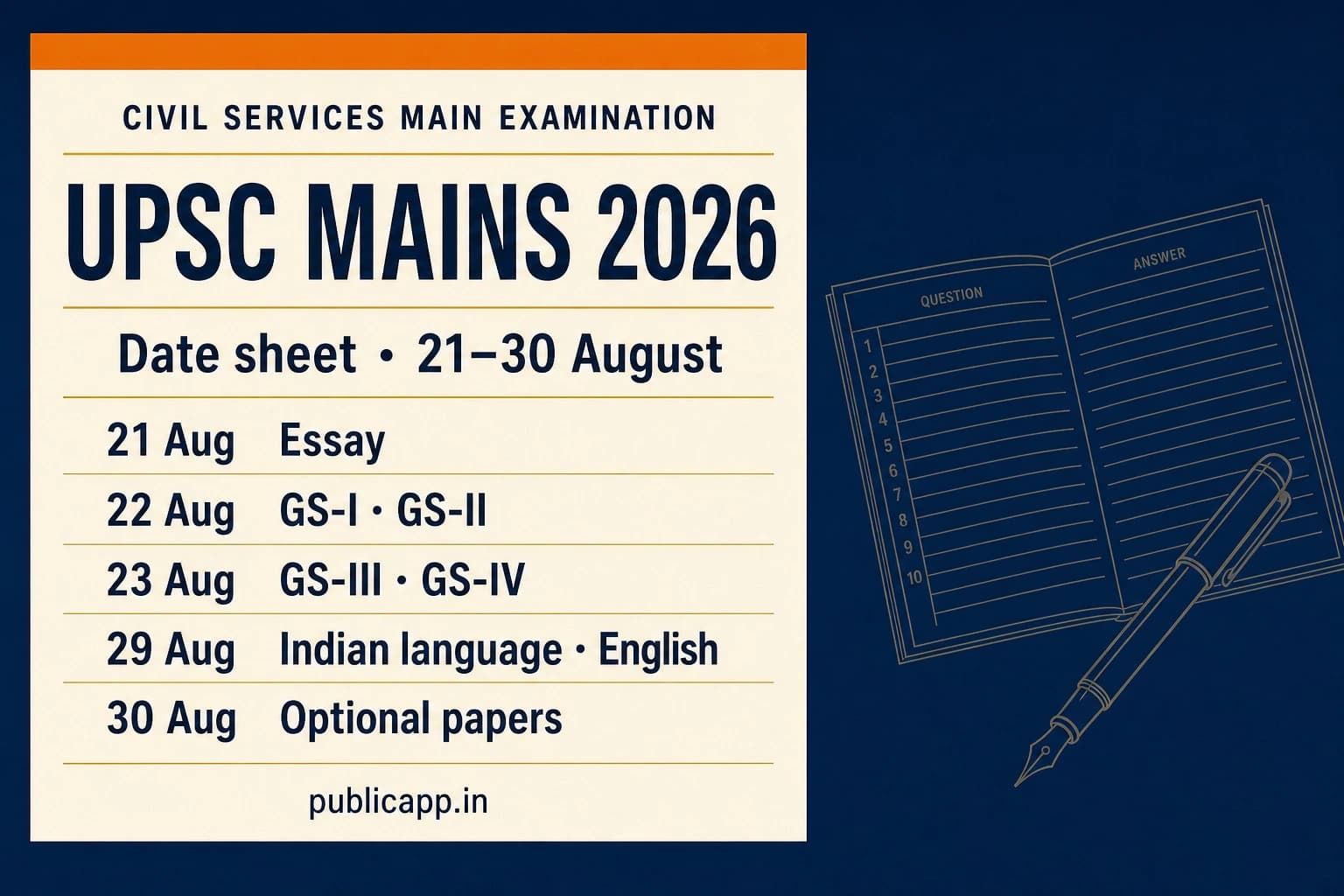
This page is a full date sheet and exam-day explainer, checked against the Commission’s official timetable PDF (uploaded 10 July 2026) and the Civil Services Examination, 2026 notification. If a line on your e-Admit Card differs from this article, follow the card.
Key facts (as of 15 August 2026)
Exam: Civil Services (Main) Examination, 2026
Dates: 21, 22, 23, 29 and 30 August 2026
Shifts: 9:00 a.m.–12:00 noon and 2:30 p.m.–5:30 p.m.
21 August: Essay only; no afternoon paper
e-Admit Card: issued 14 August 2026 on upsconline.nic.in
Helpdesk: 011-24041001
UPSC Mains 2026 paper-wise timetable
We opened the English timetable PDF on the Commission’s site on 15 August 2026. The schedule is:
Friday, 21 August 2026 — Forenoon: Paper-I Essay. Afternoon: no paper.
Saturday, 22 August 2026 — Forenoon: Paper-II General Studies-I. Afternoon: Paper-III General Studies-II.
Sunday, 23 August 2026 — Forenoon: Paper-IV General Studies-III. Afternoon: Paper-V General Studies-IV.
Saturday, 29 August 2026 — Forenoon: Paper-A Indian Language. Afternoon: Paper-B English.
Sunday, 30 August 2026 — Forenoon: Paper-VI Optional Paper-1. Afternoon: Paper-VII Optional Paper-2.
Each paper is three hours. The written exam is conventional (essay-type), not multiple choice. Paper-A lists Indian languages from the Eighth Schedule, including Hindi, Tamil, Telugu, Urdu, Bengali, Marathi and others, with specified scripts. Paper-VI and Paper-VII are the two papers of the single optional subject you chose at application — from Agriculture through Zoology, or literature of an approved language.
That five-day break after 23 August is how UPSC packed nine papers into two weekends. Use it for Paper-A and Paper-B practice and optional revision. Those language papers are qualifying: they do not add to your rank, but failing them can waste the attempt.
How to download the CSE Mains e-Admit Card
The CSE 2026 notice says eligible candidates get an e-Admit Card on the last working day of the week before the exam. For Mains, the Commission uploaded the card on 14 August 2026 on the examination page and on the online portal. No card is sent by post or email.
Open https://upsconline.nic.in or the Civil Services (Main) Examination, 2026 page on upsc.gov.in.
Choose the e-Admit Card link for Civil Services (Main) Examination, 2026.
Log in with the credentials the portal asks for — typically registration/application number and date of birth or password, plus the security code.
Check name, photograph, signature, roll number, centre address, and paper-wise timings on screen before you print.
Save the PDF and print a clear hard copy. A phone screenshot is not a substitute at the gate.
If the download fails, retrieve a forgotten registration ID from the same portal, then try again. If you still have no card, the notice tells you to contact the Commission at once — Facilitation Counter / Helpdesk 011-24041001, or email [email protected]. Waiting until 21 August is on you: the notice says a candidate who does not chase a missing card in time is solely responsible.
Correct a spelling or photo error before exam day. Mere issue of an e-Admit Card does not mean your candidature is finally cleared. UPSC verifies eligibility against original documents only after a candidate qualifies for the Interview/Personality Test.
Reporting time, photo ID, and what you can carry
The CSE 2026 notice is blunt: reach the venue at least 30 minutes before each session. Late entry is not allowed. Your e-Admit Card may print an earlier reporting time for that centre — if it does, follow the card, not this paragraph.
Face authentication is mandatory at the venue. Enter early enough for identity check and frisking, not only for the clock on the question paper.
Carry:
A printed hard copy of the e-Admit Card.
The same original photo ID you entered in the Universal Registration Number profile — Aadhaar, Voter ID (EPIC), PAN, passport, driving licence, or another photo ID issued by the State or Central Government. The notice says this card will be used for all future reference, including the Personality Test.
Only the stationery and extra items listed on your e-Admit Card (some centres ask for a spare photograph; do not assume that unless the card says so).
Leave at home:
Mobile phones, even switched off.
Smartwatches, pagers, Bluetooth devices, cameras, pen drives, and any programmable or storage gadget that can work as a communication device.
Bags, books, and valuables. The Commission says no safe-keeping is arranged and it will not be responsible for loss.
Infringement can mean disciplinary action, including a ban from future exams. If your e-Admit Card lists extra centre rules, those rules win.
What the nine papers actually count for
Mains is nine papers. Only seven count for rank. From the CSE 2026 scheme:
Paper-A (Indian language) — 300 marks, qualifying.
Paper-B (English) — 300 marks, qualifying.
Paper-I Essay — 250 marks, counted.
Paper-II GS-I (heritage, culture, history, geography, society) — 250 marks, counted.
Paper-III GS-II (governance, Constitution, polity, social justice, international relations) — 250 marks, counted.
Paper-IV GS-III (technology, economy, biodiversity, environment, security, disaster management) — 250 marks, counted.
Paper-V GS-IV (ethics, integrity, aptitude) — 250 marks, counted.
Paper-VI and Paper-VII (optional) — 250 marks each, counted.
Written total for ranking: 1,750 marks. Personality Test: 275 marks (no minimum qualifying mark). Grand total: 2,025 marks. Prelims marks are not added to this total.
You need at least 25% in Paper-A and 25% in Paper-B. UPSC evaluates Essay, GS and Optional along with the language papers, but it takes cognizance of the merit papers only for candidates who clear that 25% bar. Paper-A is not compulsory for candidates from Arunachal Pradesh, Manipur, Meghalaya, Mizoram, Nagaland and Sikkim, or for some candidates with benchmark hearing impairment who were granted a language-course exemption by their board or university — those candidates still sit Paper-B.
Paper-A and Paper-B are pitched at Matriculation standard. They still fail people who treat them as a formality. If your Indian language has gone rusty, write a full timed paper in the gap week — do not start a new GS book.
The gap week: 24–28 August
After four GS papers in three days, the timetable gives Monday to Friday before language papers. Sit one full Paper-A and one full Paper-B under time. For optional, use notes you already own: 30 August is two three-hour papers on the same day. Confirm the Mains centre on the printed card; it may not be the Prelims venue.
UPSC will announce the written result when it is ready. Candidates who obtain the minimum marks the Commission fixes for the written part are summoned for the Interview/Personality Test — about twice the number of vacancies.
After Mains: Personality Test and ranking
Final rank is written marks (Papers I–VII) plus the Personality Test. Service allocation follows rank and the preferences you already submitted. If two candidates have the same aggregate, the 2026 tie-break is: more marks in Essay + GS-I to GS-IV + Personality Test; then more marks in those five written papers alone; then seniority in age; then the Commission’s discretion.
Eligibility documents are checked after you reach the interview stage, not at the Mains gate. Keep degree proofs, category certificates, and photo ID ready, but do not expect that verification on 21 August.
Other government exams this season are a separate calendar. See the HPSC 2026 vacancy explainer and Jobs & Exams — not a substitute for upsc.gov.in.
What to do this week
Download and print the e-Admit Card today, not on 20 August.
Match the centre address with a map and a travel buffer of more than 30 minutes.
Pack photo ID, printed card, and allowed pens the night before 21 August.
Re-read the instructions printed on the card — including scribe rules if you use one. A scribe change had to be requested at least seven days before the exam.
Treat 21 August as a single Essay paper. There is no afternoon session that day; do not arrive for a second paper that does not exist.
For how publicapp.in covers exams and public-affairs explainers, see About Public App.
FAQ
When is UPSC Mains 2026?
21, 22, 23, 29 and 30 August 2026. Essay is only on 21 August morning. Language papers are on 29 August. Optional papers are on 30 August.
Is there a paper on the afternoon of 21 August?
No. The official timetable says “No Paper” in the afternoon session that Friday.
Where do I download the UPSC Mains 2026 admit card?
From upsconline.nic.in, via the e-Admit Card link on the Civil Services (Main) Examination, 2026 page. UPSC uploaded it on 14 August 2026. It is not sent by post or email.
What time should I reach the centre?
At least 30 minutes before each session, and earlier if your e-Admit Card prints a reporting time. Face authentication is mandatory. Late entry is not allowed.
Do Paper-A and Paper-B count for the IAS rank?
No. They are qualifying (300 marks each). You need 25% in each. Rank is 1,750 (Essay + four GS + two optional) plus 275 for the Personality Test.
Can I take a phone if it is switched off?
No. The 2026 notice bans mobile phones even in switched-off mode, along with smartwatches and similar gadgets. There is no cloakroom promise at the venue.
Sources
UPSC: Time Table for Civil Services (Main) Examination, 2026 (PDF, uploaded 10 July 2026) — paper-wise dates and session timings.
UPSC: Civil Services (Main) Examination, 2026 — e-Admit Card link dated 14 August 2026.
UPSC: Civil Services Examination, 2026 Notification (PDF, 4 February 2026) — e-Admit Card rules, 30-minute reporting, banned items, face authentication, Paper-A/B qualifying marks, 1,750 + 275 scheme, Personality Test.
UPSC Online Application Portal — download the e-Admit Card.
Timings, centre, and items to carry can be updated on the e-Admit Card after this article is published. We will correct this page if the Commission issues a revised timetable. Last checked: 15 August 2026.