

At Delhi’s Jantar Mantar in mid-July 2026, a 59-year-old engineer from Ladakh lay on a makeshift stage, surviving on salt water, losing roughly nine kilograms, and refusing to end an indefinite hunger strike. Around him, a youth-led movement that began as online satire had drawn opposition politicians, film actors, student unions, and round-the-clock medics. The Union government had not met the protesters. Education Minister Dharmendra Pradhan had dismissed them as a “B-team of disruptive elements.” The Delhi High Court was being asked to intervene medically. Parliament’s Monsoon Session was about to open, and organisers had called a march to the Sansad. Ten days later the fast was over, the education minister had resigned, and the same constitutional bargain in Ladakh that helped put Wangchuk in Jodhpur jail was still waiting for a published draft.
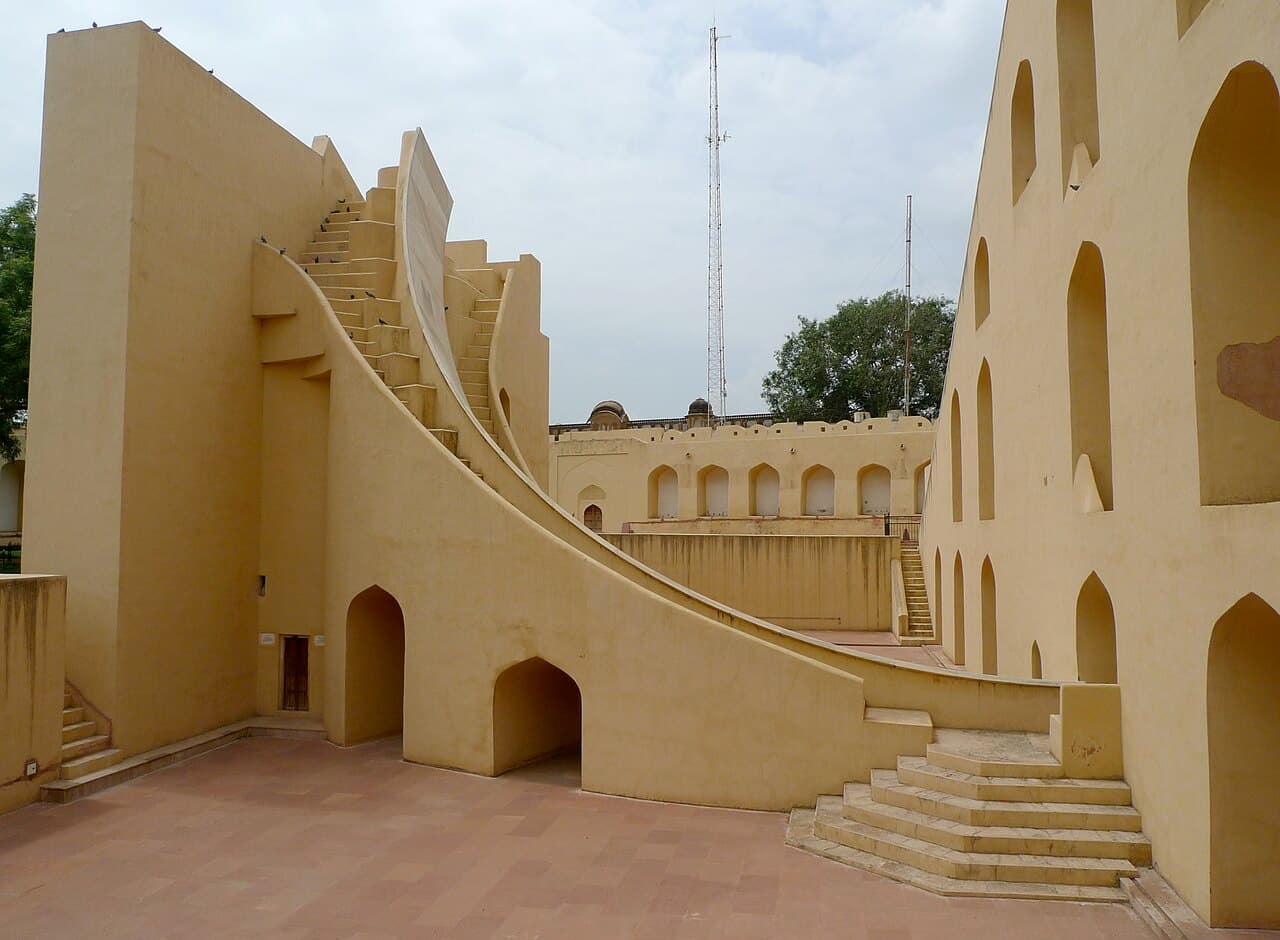
Jantar Mantar, New Delhi — the historic observatory grounds where the Cockroach Janta Party protest and Sonam Wangchuk’s hunger strike drew national attention. Photo: Wikimedia Commons.
To understand why this matters, strip away the daily drama for a moment. India watched a rare convergence: a frontier constitutional dispute that never closed; a preventive-detention saga that turned a celebrated innovator into a jail returnee; and a national entrance-exam collapse that made lakhs of families feel cheated by the state. Wangchuk is the thread tying those crises together — not because he caused all of them, but because his methods force each crisis into public view. That is why a hunger strike in central Delhi could feel larger than one man’s willpower. It was a compressed argument about how power in contemporary India answers (or refuses to answer) citizens who will not go quietly.
That scene was only the latest chapter. Behind it sits a longer, harder conflict: what happened to Ladakh after 2019; why constitutional safeguards and statehood became non-negotiable for many locals; how peaceful agitation tipped into deadly violence in Leh in September 2025; why the Centre cancelled an NGO’s foreign-funding licence and detained Sonam Wangchuk under the National Security Act for about 170 days; and why, months after his release, the same man fasted again — this time over a national exam scandal that shattered trust among medical aspirants.
This article is a full analysis of that arc. It draws on publicly reported developments from outlets including the BBC, Frontline, The Hindu, Indian Express, Al Jazeera, Reuters, The Wire, Scroll.in, ThePrint, NDTV, Hindustan Times, News18, Outlook, and others. Contested claims are attributed. The aim is not to declare a winner, but to explain what each side says, what the record shows, and why the standoff matters for Ladakh, for India’s examination system, and for the wider question of how New Delhi deals with dissent.
Who is Sonam Wangchuk?
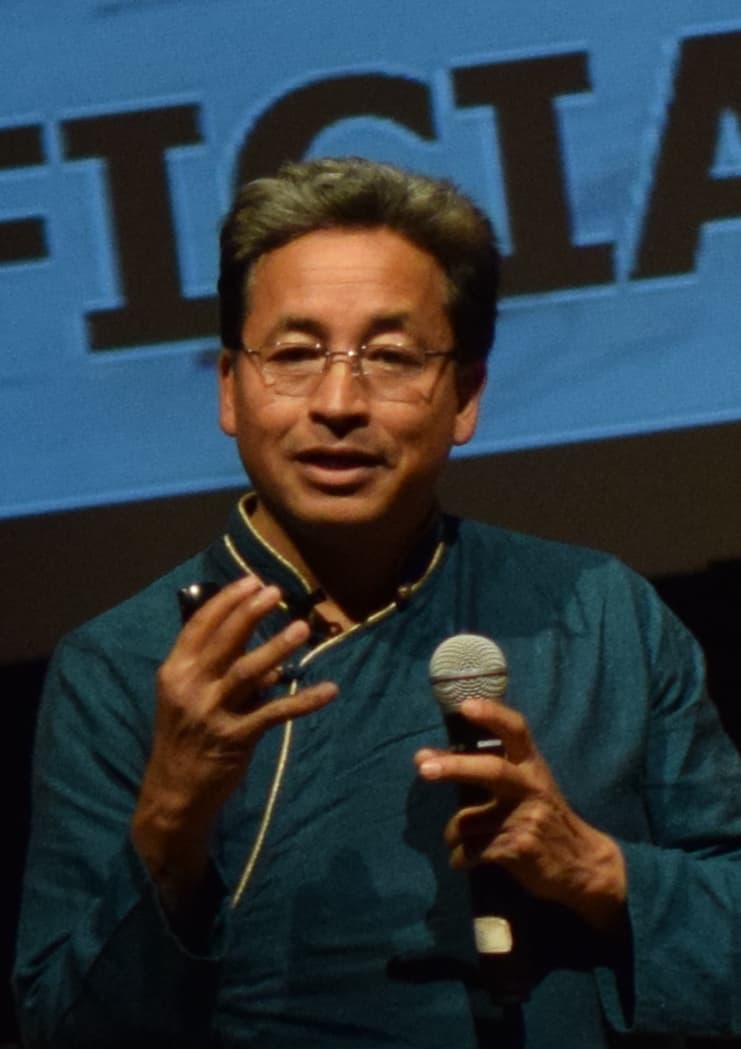
Sonam Wangchuk in 2017 — engineer, education reformer, and climate innovator from Ladakh. Photo: Wikimedia Commons.
Sonam Wangchuk was born on 1 September 1966 in Uleytokpo, a tiny village in Ladakh. According to profiles published by Frontline and other outlets, he spent his early years learning at home from his mother before moving to Srinagar when his father joined government service. School there was difficult — classes in Urdu, a language he did not know, and harsh discipline. He later studied at a Kendriya Vidyalaya in Delhi and completed mechanical engineering at the National Institute of Technology, Srinagar, graduating in 1987 after financing much of his own education.
In 1988, at 22, he returned to Ladakh and co-founded the Students’ Educational and Cultural Movement of Ladakh (SECMOL) with peers. At the time, a large majority of Ladakhi students were failing board exams written for a world that had little connection to high-altitude life. SECMOL pushed teacher training, local-language materials, and village education committees. Operation New Hope, launched in the mid-1990s, was later adopted as education policy for the region. The SECMOL campus became known for rammed-earth construction, passive solar design, and running without fossil fuels for heating, cooking, or lighting.
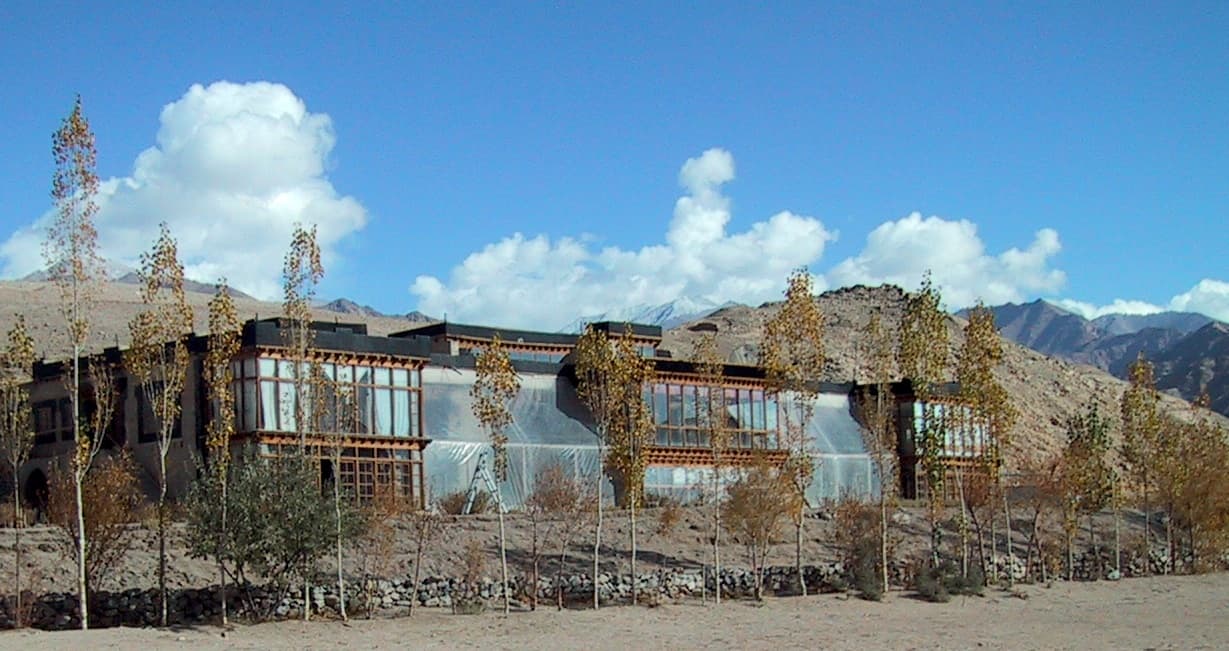
SECMOL’s main campus building in Ladakh — the education project Wangchuk co-founded in 1988. Photo: Wikimedia Commons.
Wangchuk is also associated with the “ice stupa” — conical artificial glaciers that store winter meltwater as ice and release it when farmers need irrigation in spring and summer. His work earned the Ramon Magsaysay Award in 2018 for community-driven education reform. Popular culture linked him to the spirit of Phunsukh Wangdu, the real-life inspiration behind Aamir Khan’s character in the 2009 film 3 Idiots. He appeared as a celebrity guest on Kaun Banega Crorepati. For years, he occupied a rare space in Indian public life: engineer, educator, climate innovator, and soft-spoken face of a remote region.
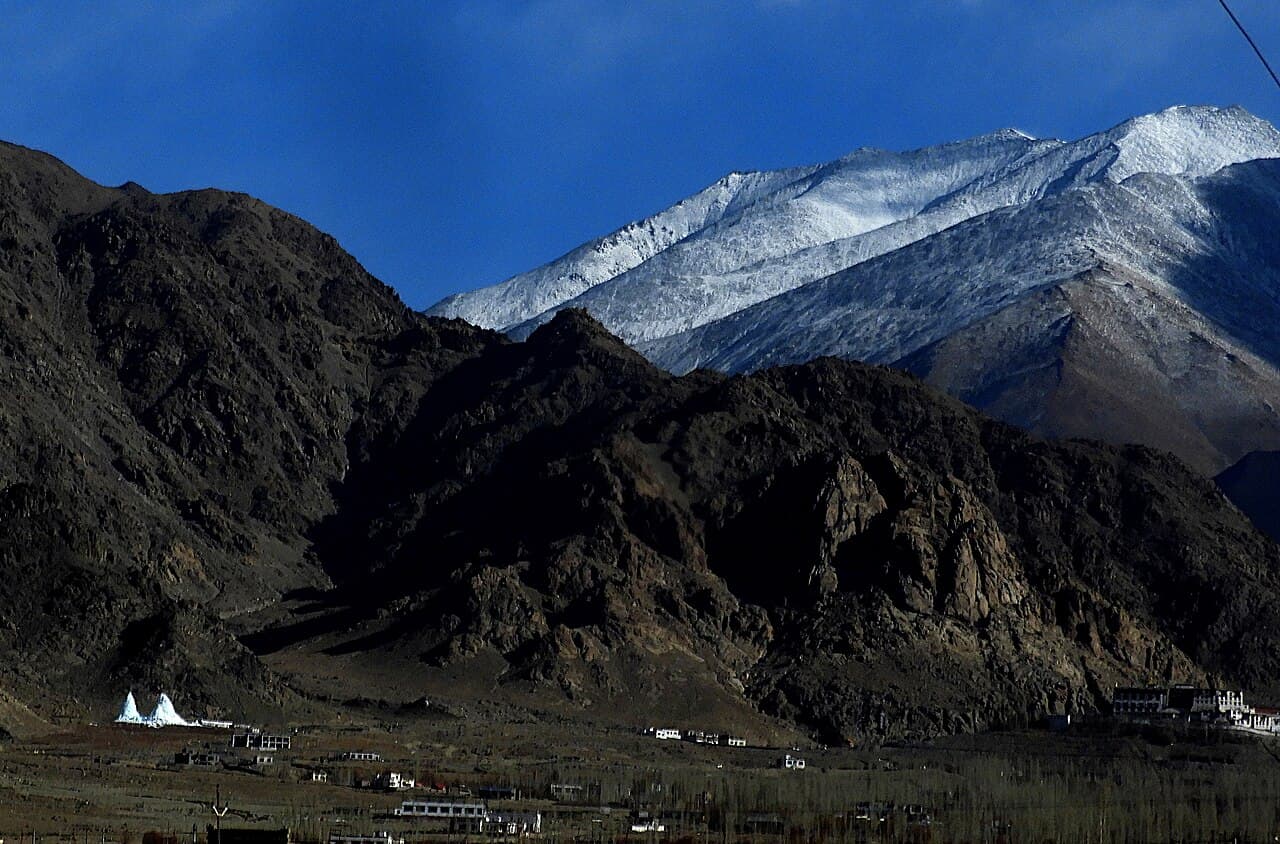
Ice stupas near Phyang monastery in Ladakh — artificial ice cones that store winter water for spring irrigation, a technique popularised by Wangchuk and SECMOL. Photo: Wikimedia Commons.
That reputation is precisely why the later clash with the state became so politically charged. When someone long celebrated as a nation-builder is detained under national-security law, or when the same person later risks death on a hunger strike in the capital, the story stops being local. It becomes a referendum on trust between citizens and government.
There is also a quieter analytical point about why Wangchuk travels so easily across India’s media and political imagination. He is not a career politician with a vote bank. He is not a separatist with a banned flag. He speaks the language of schools, glaciers, and exams — domains the Indian middle class recognises as “constructive.” That makes him useful as a bridge for Ladakhi demands that might otherwise stay trapped in regional vocabulary. It also makes him dangerous, from a hard-power perspective: a soft face can mobilise hard anger. The Centre’s later attempt to rebrand him as provocateur or financial irregularity case was, in part, an attempt to smash that soft-power advantage.
His method matters as much as his biography. Hunger strikes, climate fasts, long marches, and public letters are tools of moral theatre. They assume an audience that still believes suffering should produce response. Whether that assumption still holds in Indian politics in 2026 is one of the central questions of this entire saga.
The 2019 rupture: Ladakh as a Union Territory without a legislature
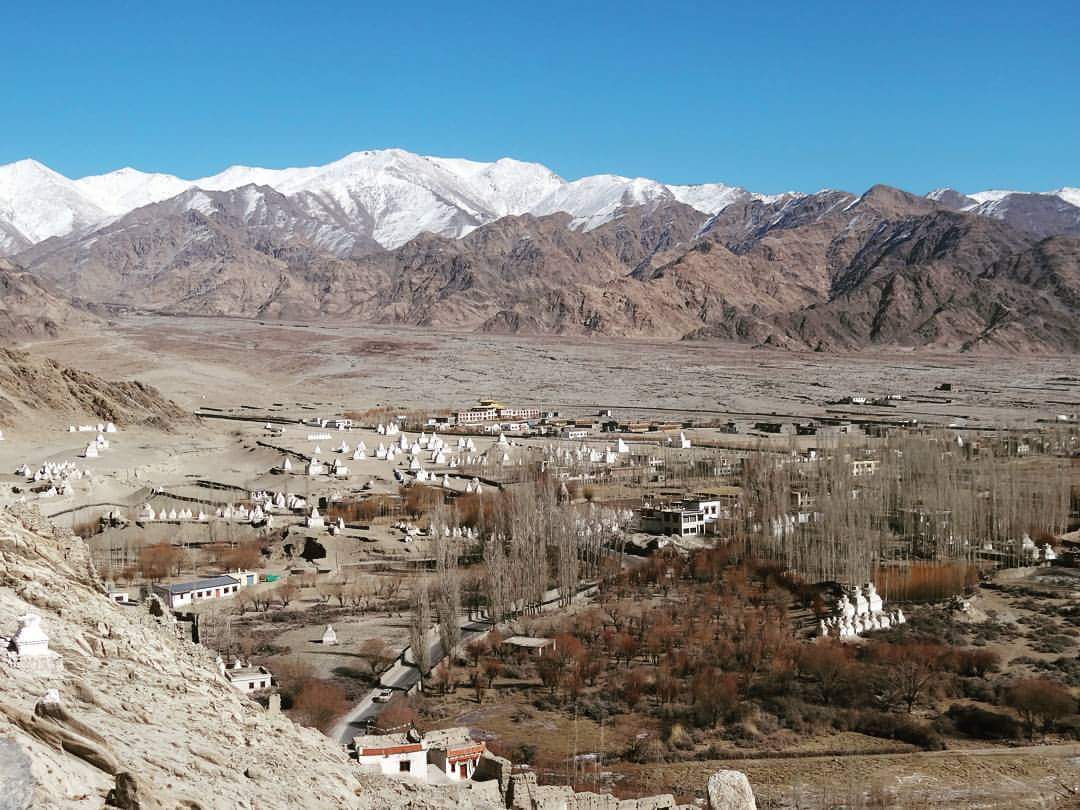
Leh, Ladakh — the high-altitude region that became a Union Territory without a legislature after August 2019, and the centre of the statehood and Sixth Schedule agitation. Photo: Wikimedia Commons.
On 5 August 2019, Parliament revoked the special status of Jammu and Kashmir under Article 370 and bifurcated the former state into two Union Territories: Jammu and Kashmir, and Ladakh. Ladakh — with a small population (about 2.74 lakh in the 2011 Census) and an overwhelmingly Scheduled Tribe demographic — initially saw widespread celebration. Many locals had long wanted separation from Kashmir Valley politics. Separation seemed, at first, like recognition.
The celebration faded when the constitutional package became clearer. Ladakh received Union Territory status without a legislative assembly. There was no state legislature, no public service commission of its own in the usual state sense, and no elected body with full law-making powers. The Leh and Kargil Autonomous Hill Development Councils continued as local bodies, but they were not a substitute for a state legislature. Before 2019, as part of Jammu and Kashmir, residents had lived under Articles 370 and 35A-era protections that shaped land and employment rules. Those protections vanished with the larger constitutional change.
Civil society soon coalesced around a demand package. The Leh Apex Body (LAB) and the Kargil Democratic Alliance (KDA) — coalitions of socio-political and religious groups from Leh and Kargil — organised agitation from around 2021 onward. Core demands typically included:
Statehood for Ladakh, with an elected legislature;
Inclusion under the Sixth Schedule of the Constitution, which grants autonomous district councils legislative, judicial, and financial powers in specified tribal areas (currently applied in parts of Assam, Meghalaya, Tripura, and Mizoram);
Separate parliamentary representation for Leh and Kargil;
Jobs, domicile protections, cultural safeguards, and environmental protections against unregulated mining and large projects.
The National Commission for Scheduled Tribes had recommended bringing Ladakh under the Sixth Schedule, noting that more than 97 per cent of the region’s population consists of Scheduled Tribes — among the highest such concentrations in India. The BJP’s 2019 Ladakh manifesto, according to multiple reports including Mongabay-India and Frontline, listed Sixth Schedule implementation among its top priorities for the region. Similar assurances were reported ahead of the 2020 Hill Council elections. For many Ladakhis, those promises were not optional talking points. They were the political bargain that made Union Territory status acceptable. A useful overview of the longer agitation is also available on Wikipedia’s Ladakh protests page and in The Hindu’s Explained series.
Why Sixth Schedule and statehood matter
To outsiders, “Sixth Schedule” can sound like a technical constitutional footnote. Inside Ladakh, it is shorthand for survival of land, culture, and ecology in a region that is both fragile and strategically vital.
Without strong local legislative control, residents and ecologists have argued, land and natural resources become easier for outside capital to acquire. Mining, tourism infrastructure, and large renewable-energy projects can proceed with less meaningful local consent. Jobs can flow to non-locals in a tiny labour market. Cultural and linguistic identity — already under pressure from demographic and economic change — loses institutional shields. Statehood, in this framing, restores democratic accountability: an elected house that can make laws, scrutinise the administration, and speak for the region in India’s federal system.
The Union government’s counter-logic, as reported over successive rounds of talks, has been different. Officials have pointed to funds flowing to the Union Territory, administrative reforms, new districts, domicile rules, and job reservations as proof that New Delhi is addressing local concerns without necessarily granting Sixth Schedule status or full statehood. A Press Information Bureau release described the High-Powered Committee (HPC) chaired by MoS Home Nityanand Rai as the forum for culture, land, employment, and development discussions with LAB and KDA. ThePrint reported agreements in principle on high local job quotas and related measures even while statehood and Sixth Schedule remained unresolved. By early 2024, according to reports in The Quint, The Diplomat, and Frontline — and later echoed in Indian Express after the 2025 violence — Home Minister Amit Shah had indicated that neither Sixth Schedule status nor a legislature would be accommodated, with other “constitutional safeguards” (including possibilities under Article 371) discussed as alternatives. Talks between LAB, KDA, and the Ministry of Home Affairs repeatedly stalled after multiple rounds.
Geography intensifies every argument. Ladakh borders China and Pakistan. The 2020 Galwan clash killed Indian and Chinese soldiers in the region. The Indian Army maintains a large presence. From New Delhi’s security perspective, a sparsely populated frontier UT under direct central control can look like strategic clarity. From Leh and Kargil’s civic perspective, the same arrangement can look like democratic deficit at the very edge of the republic — people asked to bear the burdens of a borderland without the full political voice of a state.
Wangchuk’s demand, as The Wire and allied coverage framed the local movement’s core claim, is “neither secessionist nor radical.” It is a demand for constitutional tools already used elsewhere in India for tribal regions — plus the ordinary democratic furniture of statehood.
Leh and Kargil: unity that the Centre cannot ignore
One under-discussed strength of the Ladakh movement is the unusual coordination between Buddhist-majority Leh (through LAB) and Muslim-majority Kargil (through KDA). In a country where religious polarisation often fragments politics, this joint charter — statehood, Sixth Schedule, jobs, dual parliamentary seats — has been a durable coalition. That matters analytically because New Delhi cannot easily dismiss the agitation as one community’s grievance. It also raises the stakes of any settlement: a deal that satisfies only one side of the Indus divide would reopen fissures the movement has worked hard to close.
The Centre’s preferred tools — domicile rules, job quotas, women’s reservation in hill councils, language recognition, new districts — are not empty. They address real anxieties about employment and cultural visibility. But they are executive or administrative answers to what locals frame as a constitutional problem. You can raise a quota by notification. You cannot, by notification alone, create a legislature with the permanence and symbolic dignity of statehood, or the entrenched autonomy of Sixth Schedule councils. That mismatch — real concessions that still miss the demand’s constitutional core — helps explain why talks can look “productive” in Delhi press releases and “empty” in Leh and Kargil streets.
Escalation: fasts, marches, and stalled talks (2023–2025)
Wangchuk did not invent the Ladakh movement, but he became one of its most visible amplifiers — especially through hunger strikes and climate framing.
In January 2023, he held a short fast in sub-zero temperatures highlighting environmental risks from mining and industrial plans. LAB and KDA organised joint protests in Ladakh and Delhi. In March 2024, Wangchuk undertook a 21-day “climate fast” in Leh demanding Sixth Schedule status — covered in detail by Frontline and Mongabay-India. Later that year he led a nearly 1,000-kilometre “Delhi Chalo Padayatra” from Leh toward the capital; marchers were detained by Delhi Police at the Singhu border before entering the city. By March 2024, multiple rounds of talks had remained inconclusive.
Through late 2024 and into 2025, a High-Powered Committee process continued in fits and starts. Meetings were reported in December 2024, January 2025, and May 2025; some leaders met the Home Minister. The Centre announced five new districts — Zanskar, Drass, Sham, Nubra, and Changthang — and other administrative measures. Local leaders said assurances on the core constitutional questions remained incomplete. Wangchuk, in interviews, described a “significant democratic deficit” and warned he would resume fasting if dialogue stayed unproductive.
On 10 September 2025, LAB initiated a 35-day hunger strike for resumption of result-oriented talks. About 15 people joined the fast; Wangchuk also began fasting. A next round of talks was scheduled for 6 October in New Delhi. Wangchuk publicly criticised the timing as unilateral and delayed, demanding earlier, outcome-focused negotiations. The temperature in Leh rose — politically and on the street.
24 September 2025: violence in Leh
On 24 September 2025, a protest in Leh demanding statehood turned violent. Four people were killed in clashes with security forces; dozens were injured, including many young people according to several reports. Property damage included attacks on a BJP office and other targets; a CRPF vehicle was among those reported damaged or torched. It was widely described as the bloodiest day of the Ladakh agitation — see contemporaneous accounts from Reuters, Scroll.in, and The Wire.
What happened next shaped the entire Wangchuk–government confrontation.
The Ministry of Home Affairs blamed the violence on “provocative statements” by Wangchuk that, it said, “incited” the mob. Officials argued that certain politically motivated individuals were unhappy with the progress of talks and were trying to sabotage dialogue. Ladakh’s police leadership, speaking to ThePrint, alleged that Wangchuk and some Congress members had incited people; DGP S.D. Singh Jamwal was quoted linking Wangchuk’s speeches to references to unrest in Sri Lanka and Nepal, and noting that Wangchuk had visited Islamabad — framing used to suggest a pattern of dangerous politics. Wangchuk, who had been on hunger strike, distanced himself from the violence, saying it damaged a peaceful struggle of five years and urging youth to remain peaceful. He called off his fast after the violence broke out. Scroll reported that he told The Hindu he was not afraid of arrest but accused authorities of making him a scapegoat.
Two facts can be true at once in public debate even when they collide in politics: (1) four civilians died and public order collapsed in a sensitive border region, which any government will treat as a security crisis; (2) blaming a single hunger-striking activist as the proximate cause, then moving immediately to FCRA cancellation and NSA detention, will be read by supporters as criminalising a constitutional movement. The rest of this story is the collision of those two readings.
Reading the riot: cause, catalyst, or scapegoat?
Serious analysis has to resist two lazy stories. The first lazy story says the violence “proves” Wangchuk wanted chaos. Speeches can inflame; hunger strikes can gather crowds; crowds can escape organisers. But causation in a riot is rarely a single microphone. Years of stalled talks, youth unemployment anxiety, land fear, and the emotional charge of a long fast create tinder. A speech may be a spark, or it may be the nearest convenient spark after the fire starts. The second lazy story says the state invented the riot to crush dissent. Four deaths and burnt buildings are not inventions. Police firing, curfew, and internet suspension after the clash — reported by Reuters, Hindustan Times, and others — show a genuine breakdown of order.
The sharper question is institutional: after a riot, does the state open a transparent inquiry into force and command decisions, while also prosecuting clear criminal acts, or does it collapse the entire political movement into one villain and one preventive-detention order? The first path strengthens rule of law. The second path may restore quiet faster — and plant deeper grievances. September 2025 looked, to many observers, closer to the second path. That does not settle Wangchuk’s individual legal liability; it judges the political design of the response.
The government case: FCRA, CBI, HIAL, and the National Security Act
Within a day of the Leh violence, the Union Ministry of Home Affairs cancelled the FCRA registration of SECMOL. The order cited repeated violations of the Foreign Contribution (Regulation) Act. A show-cause notice had been served earlier (reports mention 20 August, followed by a 10 September letter). Detailed reporting appeared in Indian Express, NDTV, and The Times of India. The CBI had already begun a preliminary inquiry into alleged FCRA violations connected to Wangchuk’s institutions roughly two months earlier, following an MHA complaint — as reported by Indian Express and Economic Times.
Government and media sourcing around the financial allegations painted a broad picture. Among claims reported by NDTV and others:
Alleged acceptance of foreign funds by institutions linked to Wangchuk before proper FCRA clearance;
Alleged routing of domestic funds through FCRA-designated accounts;
Sharp jumps in donations across years and multiple bank accounts, some allegedly undeclared;
Alleged diversion of reserves to a private company (Sheshyon Innovation Pvt. Ltd.), with Wangchuk and Gitanjali Angmo named as directors in reporting;
Specific SECMOL transaction disputes — for example, deposits into FCRA accounts that the organisation explained as sale proceeds of an old bus purchased with FCRA funds, which the government called untenable.
Separately, the Ladakh administration had cancelled a long land lease for the Himalayan Institute of Alternatives, Ladakh (HIAL) in August 2025, citing non-utilisation for intended purposes and lease-agreement issues. Tax and regulatory pressure had been building in the months before the September flashpoint. From the state’s viewpoint, these were compliance actions that happened to coincide with political unrest. From Wangchuk’s viewpoint, they were a coordinated squeeze.
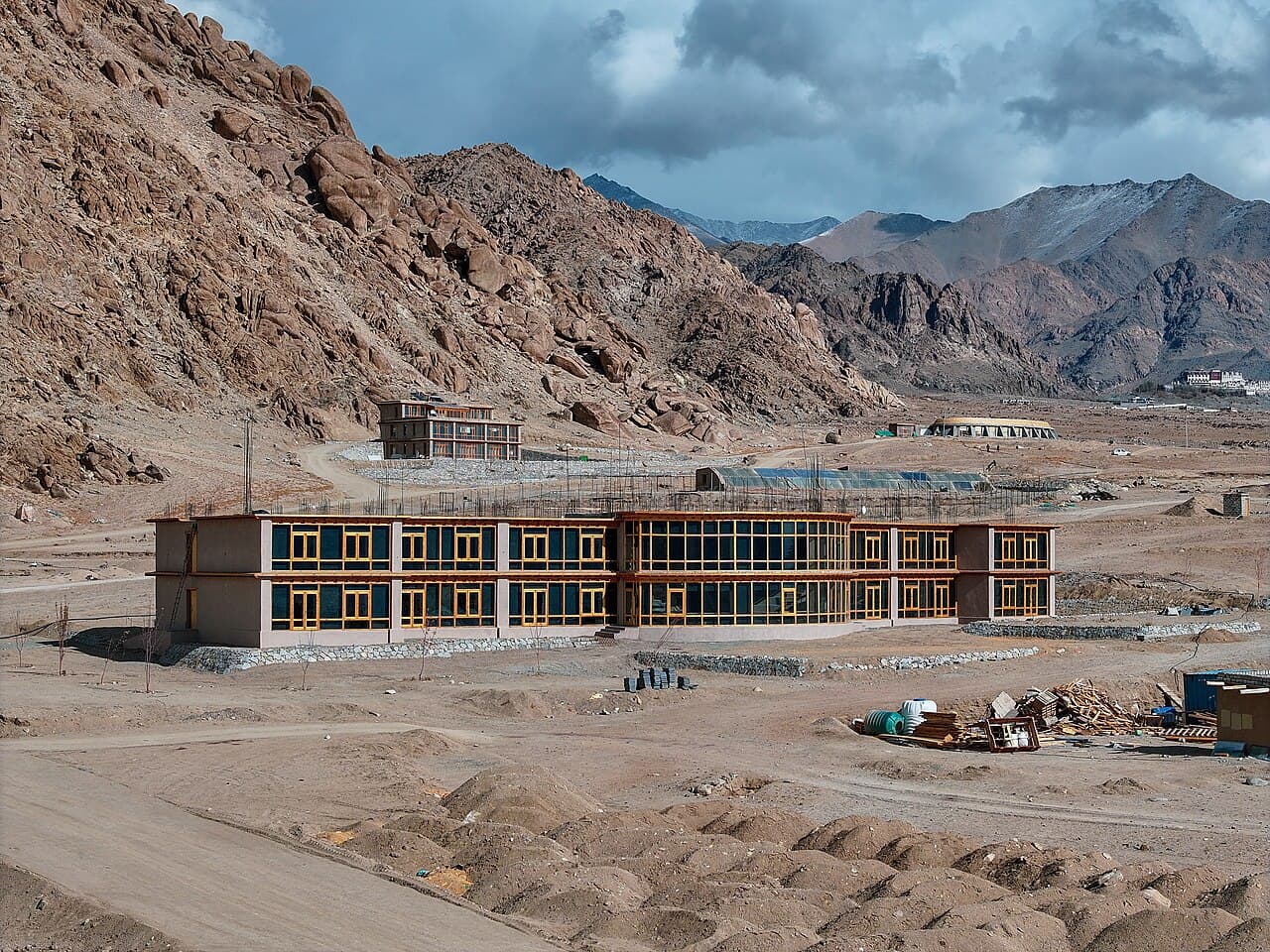
HIAL campus in Ladakh — the institute founded by Wangchuk that came under CBI FCRA scrutiny and saw its land lease cancelled in 2025. Photo: Wikimedia Commons.
On 26 September 2025 — two days after the violence — Wangchuk was detained under the National Security Act and transferred to Jodhpur Central Jail, more than a thousand kilometres from Leh. The Ladakh administration said he had been “indulging in activities prejudicial to the security of the State and detrimental to maintenance of peace and public order,” and that detention was needed to prevent further prejudice to public order — language quoted at length by The Wire and confirmed in wire reporting by Reuters. Under the NSA, a person can be preventively detained for up to 12 months without a conventional criminal trial on the detention itself. It is among India’s most severe ordinary preventive-detention frameworks.
This is the heart of the government’s public narrative:
Public order: Speeches and agitation allegedly tipped a protest into deadly riot.
Financial irregularity: FCRA and related probes allegedly showed serial non-compliance by his NGOs/institutes.
Dialogue sabotage: Unrest allegedly undercut official talks with LAB/KDA.
Security: In a China-facing border UT, New Delhi will not tolerate what it frames as incitement.
Whether every financial allegation would survive courtroom scrutiny is a separate question from the political use of timing. Critics noted that cancellation and arrest followed immediately after violence — even though FCRA notices predated it — creating an optics of punitive stacking.
Why distant detention matters
Transferring Wangchuk to Jodhpur was not a logistical footnote. Preventive detention already removes the detained person from ordinary trial safeguards; distance multiplies the isolation. Family visits become harder. Local political pressure in Leh becomes weaker. Media access shrinks. The message to the region is that the Centre can relocate a popular face out of the theatre of his own movement. Supporters called this punitive geography. Officials would call it prudence in a volatile UT. Both descriptions can be strategically true: isolation is useful precisely because it is harsh.
NSA’s design rewards this logic. Because detention is preventive, the state does not have to prove a conventional criminal case to the public’s satisfaction before removing someone from the street. An advisory board process exists, but it is not a full trial in the public imagination. For a government facing frontier unrest, that speed is attractive. For a constitutional democracy that claims to prefer speech and association over preventive confinement, that speed is also a warning light. The Wangchuk case became a national story partly because the person detained was famous enough to make the warning light visible.
Wangchuk’s defence and the movement’s counter-narrative
Wangchuk and his supporters told a different story.
On the FCRA inquiry into HIAL, Wangchuk told PTI that CBI teams were examining foreign receipts, but that the contested items were service agreements — knowledge export to the United Nations, a Swiss university, and an Italian organisation — with taxes paid. “We don’t want to be dependent on foreign funds, but we export our knowledge and raise revenue,” he said, as quoted in The Times of India and CNBC-TV18. In three instances, he claimed, investigators treated revenue as foreign contribution. He said he had not been personally questioned at the time of those visits. SECMOL and HIAL, supporters stressed, educate students who cannot afford fees; HIAL students also receive stipends for project work.
On politics, Wangchuk had anticipated detention. Before arrest he told PTI he expected a Public Safety Act-style case and said he was ready — adding that “a Sonam Wangchuk in jail may cause them more problems than a free Sonam Wangchuk.” He rejected the charge that he wanted violence. The Leh Apex Body’s lawyer and other local leaders framed the larger demand as constitutional, not anti-national. After years of marches and fasts, they argued, the Centre’s refusal on Sixth Schedule and statehood — despite earlier political promises — produced the frustration that boiled over in September, and then the state blamed the messenger.
International and national rights-leaning coverage emphasised the transformation of Wangchuk’s public image: from celebrated innovator and Magsaysay awardee to alleged “traitor” overnight. Al Jazeera and others noted New Delhi’s accusation of “provocative speeches” after a hunger strike for statehood or Sixth Schedule protections. For the movement, the sequence — FCRA cancellation, NSA detention, distant jail — looked less like neutral law enforcement and more like an attempt to decapitate a popular agitation.
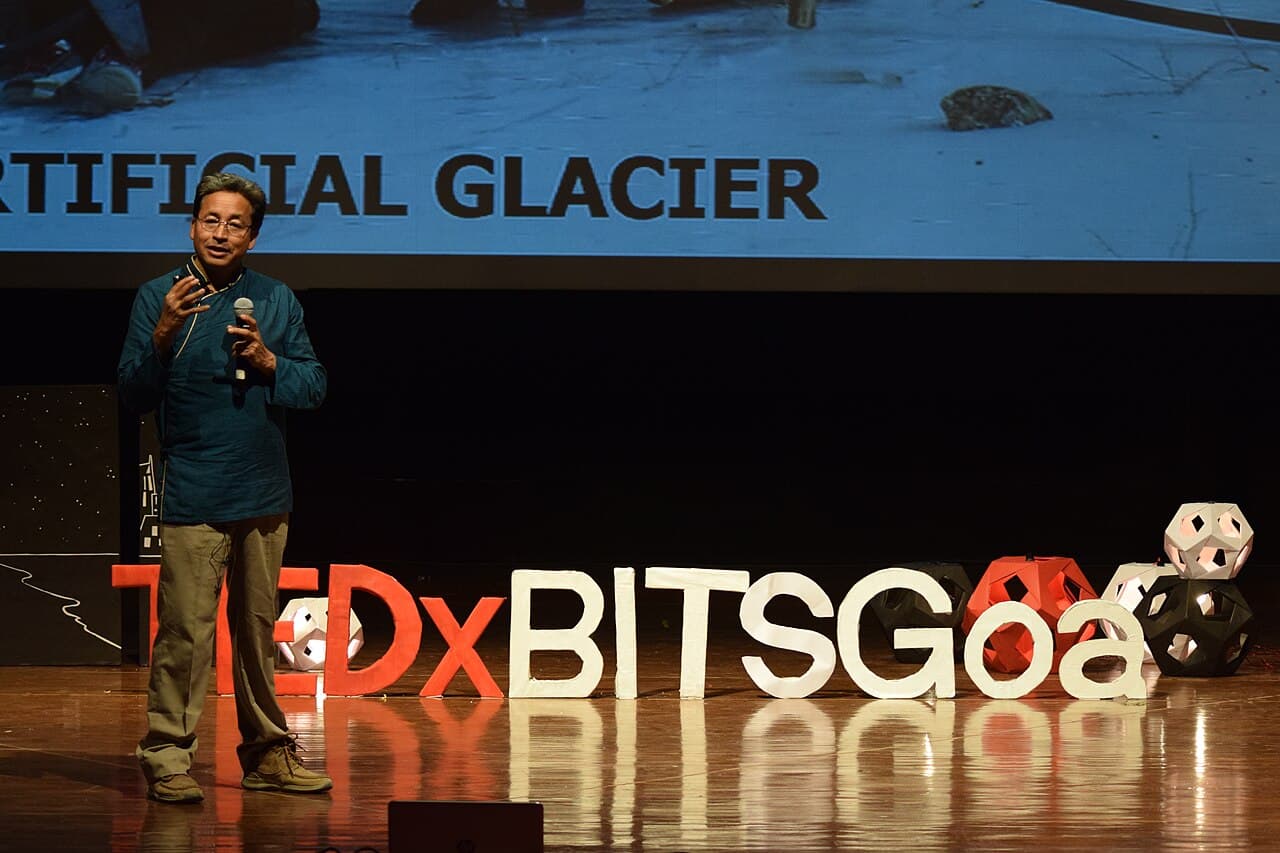
Wangchuk at a public event — the soft-spoken educator whose public image swung from national innovator to NSA detainee after September 2025. Photo: Wikimedia Commons.
“I am neither Gandhi nor a hero. I am just an ordinary citizen who has tried to fulfil his responsibilities.” — Sonam Wangchuk, later, at Jantar Mantar (as reported during the 2026 fast)
That line matters because it captures the persona he projects: not a party boss, not a secessionist firebrand, but a civic moralist. Governments often find moralists harder to manage than party opponents. Party opponents can be bargained with. Moralists force the state to choose between engagement and hardness — and hardness then becomes the story.
There is a strategic irony here. If the Centre’s goal after September 2025 was to shrink Wangchuk’s political capital, detention may have done the opposite in the long run. Jail converts a regional educator into a national symbol. Release then returns that symbol to the field with a new layer of martyr-adjacent credibility. Within months he was fasting in Delhi on a student issue that millions of Indian families understood immediately. Whether or not one agrees with his tactics, the sequence shows how security tools can inadvertently nationalise a local leader.
170 days under NSA, then release
Wangchuk remained in Jodhpur Central Jail for about 170 days. His wife, Gitanjali Angmo, filed a habeas corpus petition in the Supreme Court challenging the legality of the detention. Other activists and LAB-linked figures also faced pressure and cases in the aftermath of the September unrest.
On 14 March 2026, the Ministry of Home Affairs revoked the detention with immediate effect. The statement said the government remained “committed to fostering an environment of peace, stability and mutual trust in Ladakh so as to facilitate constructive and meaningful dialogue with all stakeholders.” Wangchuk was released from Jodhpur that afternoon — covered by Indian Express, Al Jazeera, and Scroll.in. The decision came two days before a scheduled Supreme Court hearing on the habeas petition. Scroll reported that the Centre had described Wangchuk as the “chief provocateur” of the September 24 violence and claimed protests came under control after he was taken into custody — a characterisation his supporters reject. Whether charges or other proceedings continued separately was not always clear in early reporting; NSA revocation ends the preventive detention order, but does not by itself erase every parallel investigative track.
Release did not settle the Ladakh question. It paused the most extreme personal confrontation and reopened political space for dialogue language.
Analytically, the March 2026 revocation can be read several ways at once. It may have been a genuine pivot toward dialogue after winter cooled tempers. It may have been litigation risk management ahead of a Supreme Court hearing that could have produced uncomfortable questions about the detention’s factual basis. It may have been a calculation that Wangchuk free but constrained was less costly than Wangchuk detained under continuous national headlines. States rarely announce their real mix of motives. What can be said is that “dialogue” returned as official vocabulary at the exact moment detention became harder to sustain politically and legally — and that Ladakh’s core constitutional demands remained unfinished business either way.
Dialogue without a draft: Ladakh after the jail door opened
Wangchuk’s first public notes after jail were conciliatory. He told reporters he wanted judicial closure of his case, suggested “linguistic misunderstandings” may have fed the detention grounds, and urged both the Centre and Ladakhis toward a “give and take” that was not framed as one side’s total victory. The Hindu and Indian Express recorded that tone. LAB and KDA, by contrast, kept repeating that statehood and Sixth Schedule were not optional talking points.
On 22 May 2026, Wangchuk sat in a LAB–KDA delegation that met Home Ministry officials — the first such meeting since an inconclusive 4 February HPC round, and the first time he himself attended talks with the ministry after release. The Hindu reported the encounter as a sub-committee meeting rather than a full political settlement. Out of it came an in-principle understanding that would define the next phase: while statehood would remain Ladakh’s long-term aspiration, the immediate step would be a Union Territory-level elected body with executive, financial, and legislative powers, plus a customised constitutional shield drawn from Article 371 rather than an immediate Sixth Schedule notification.
Wangchuk, speaking after the meeting, emphasised the fiscal piece. Under the arrangement as he described it to IANS and The Hindu, the Lieutenant Governor would no longer decide the bulk of the UT budget; elected leaders of the new body would. The Centre’s argument, he said, was that Ladakh did not yet have the revenue base of a full state, so operational costs could not simply be shifted onto a new state exchequer. Studies would follow. If the resource picture changed, so might the model. That is the language of a holding settlement: democracy now, statehood later, if the numbers and the politics allow.
The paper then stalled. LAB and KDA accused the Centre of altering draft minutes — especially language on the elected body’s control over the bureaucracy, including the Chief Secretary and Annual Performance Appraisal Reports. Leh and Kargil observed a shutdown on 23 June over the missing or disputed record. On 3 July, in Leh, MHA officials and local leaders finally signed the May 22 minutes. The Hindu and The Wire reported the agreed formula: a “customised sui generis” model under Article 371 (A to J as precedents, not as a photocopy); a UT-level elected body with executive, financial, and legislative powers; statehood parked as a long-term aspiration; and a further draft, still to be written, on how that body would sit with Panchayati Raj institutions and the civil service.
That draft had not arrived by late July. The New Indian Express quoted KDA co-chairman Sajjad Kargili saying there had been “no concrete steps or official communication,” and that groups were still waiting for the MHA’s promised structure of the elected body and Article 371 safeguards. LAB and KDA have said they will not treat a Territorial Council — with a Hill Council Chief Executive Councillor serving as a kind of UT chief minister — as a substitute for their core demands. By mid-August they were preparing district-level mobilisation after Independence Day, around 17 August, to push the Centre to put a draft in public and resume official talks, according to local reporting. LAB held back its own counter-draft until the ministry published first.
This is the face-saving ambiguity the later Delhi crisis would also produce. A legislature-like body without calling it statehood. Article 371 instead of the Sixth Schedule. Minutes signed, paper unpublished. Locals can claim democracy is returning; the Centre can claim it never conceded a new state on a China-facing frontier. Until a draft is public, both claims are promissory notes. Promissory notes are how Indian federal disputes are often managed. They are also how they explode again.
That unfinished paper did not stop the next crisis. Within months of leaving Jodhpur, Wangchuk was fasting again — not in Leh this time, but in Delhi, on a national education scandal that intersected with his lifelong identity as an educator.
The second crisis: NEET-UG 2026, CJP, and a fast “for six weeks or death”
On 3 May 2026, more than 22.8 lakh students sat the NEET-UG medical entrance examination. On 12 May, the exam was cancelled after investigations confirmed that question papers had been leaked before the exam date. A re-examination was held on 21 June. Media reports linked the scandal and cancellation to multiple student suicides — figures cited in protest coverage often mentioned at least eleven deaths. Trust in one of India’s most consequential gatekeeping exams collapsed for a generation of aspirants and parents.
Out of that anger emerged the Cockroach Janta Party (CJP). The name was a satirical response to remarks by Chief Justice of India Surya Kant in mid-May 2026 — 15 May in contemporaneous protest coverage, 16 May in later reconstructive reporting — who referred to some activists and unemployed youth as “cockroaches” and “parasites of society” in open court. The Court later said, according to The Times of India, that the comment had been taken out of context. Political communications strategist Abhijeet Dipke registered the name and launched the party online within a day. CJP began protest at Jantar Mantar on 20 June 2026. Core demands included:
Resignation of Union Education Minister Dharmendra Pradhan, on the argument that the minister must take moral responsibility for paper-leak failures;
Rs 1 crore compensation for families of students who died by suicide in the aftermath;
Broader accountability and reform of the public examination system.
Wangchuk joined on 28 June and began an indefinite hunger strike. He framed his participation as that of an educator: students had done nothing wrong; the state’s failure produced the leak; yet students suffered. He announced the fast as his sixth major hunger strike — “for six weeks or death,” as quoted by Frontline. Surviving on salt water, he lost weight rapidly. By mid-July, medical bulletins reported losses approaching or exceeding 8–9 kg; The Hindu cited CJP bulletins putting his weight near 57 kg with BP around 105/76; the BBC reported a 9.1 kg loss by day 19. Later reconstructive coverage put the total closer to 11 kg. Doctors warned about muscle wasting and eventual organ risk. A fellow faster from a student organisation was hospitalised after fainting. Outlook and News18 tracked his refusal to break the fast despite political appeals.
Pradhan ruled out resignation and dismissed CJP and supporters as a “B-team of disruptive elements.” As of mid-July 2026 — roughly 25 days into the CJP agitation and nearly three weeks into Wangchuk’s fast — no Union official had met the protesters, according to Frontline and Reuters reporting. CJP spokesperson Saurav Das compared the silence unfavourably even to colonial-era responses to hunger strikes: a Magsaysay awardee was fasting, he said, and his own government would not hear him out. Day-by-day political developments were also tracked in Hindustan Times live blogs.
Wangchuk’s second demand thread — unfinished Ladakh constitutional status — never fully left the stage. In posts and statements during the fast, he linked the student deaths to a larger failure of conscience, and also to protecting “the mountains of Ladakh” and “the rivers of India.” The 2026 strike was therefore both a NEET protest and a continuation of his method: put the body on the line until authority must choose visibility or engagement.
Why an educator’s body became a national exam protest
On paper, Ladakh statehood and a NEET paper leak look like unrelated files. In Wangchuk’s public ethics, they share a spine: institutions that ask citizens for obedience must themselves be trustworthy. A frontier people asked to accept Union Territory rule without a legislature are being asked for political trust. Students asked to stake years of study on a single exam are being asked for procedural trust. When either trust collapses, Wangchuk’s instinct is not petition-writing alone but embodied protest — the body as evidence that the grievance is not theatrical.
CJP’s satire is also worth taking seriously as political technology. By reclaiming a judicial insult — “cockroaches” — young organisers flipped stigma into identity. The costumes and meme energy at Jantar Mantar were easy to mock; they were also how Gen-Z movements recruit in an attention economy. Wangchuk’s arrival gave the satire a moral seriousness it lacked. CJP gave Wangchuk a ready-made national stage and a demand (ministerial resignation) sharper than the multi-year constitutional grind of Ladakh talks. Together they produced a hybrid protest: half meme party, half satyagraha, aimed at an education minister and, by extension, at a style of governance that treats public anger as noise.
The demand for Pradhan’s resignation was maximalist by design. Cabinets rarely resign over exam failures even when the failures are severe. That does not make the demand irrational. Maximalist demands create bargaining room and force the question of moral responsibility into headlines. A government that refuses even to meet protesters for weeks, however, converts a negotiable accountability dispute into a test of state empathy. Silence then becomes its own message: we will not be moved by hunger, satire, or celebrity appeal. Whether that message projects strength or brittle arrogance depends on the audience — and India now has many audiences watching at once.
Politics, celebrities, and the Delhi High Court
As Wangchuk’s health worsened, Indian politics performed a familiar dance.
Opposition leaders — including Mamata Banerjee, Akhilesh Yadav, Arvind Kejriwal, Uddhav Thackeray, and Shashi Tharoor — urged him to break the fast while criticising government silence. Thackeray’s Shiv Sena (UBT) announced support for CJP and called for solidarity protests; the party mouthpiece Saamna compared the BJP’s old support for Anna Hazare’s 2011 Lokpal fast with its current non-engagement, calling the contrast hypocrisy. CPI(M) and Shiv Sena-UBT MPs visited Jantar Mantar and promised to raise the issue in Parliament. AAP’s Kejriwal scheduled a visit to the protest site around 16 July. BJP voices, for their part, attacked the optics of Opposition patronage — including claims that Wangchuk was being used as an extension of rival parties.
From cinema and culture, Omi Vaidya (Chatur from 3 Idiots) posted that he did not want “Phunsukh Wangdu to die.” Zeenat Aman, Naseeruddin Shah, Ratna Pathak Shah, Prakash Raj, and others asked for dialogue. More than 1,800 artistes, writers, academics, and activists signed a statement urging Wangchuk to stop because, they argued, “the government does not have a heart or a conscience” — a grim admission that fasting only works if the other side cares enough to respond.
Wangchuk refused. He told the BBC he had to take what he had begun to its logical conclusion. In a mid-July video he said his condition was not such that he would die in two to four days; vitals were “normal for an 18-day fast,” though he was weak and losing muscle. He asked supporters to join the 20 July march to Parliament rather than only send couch messages.
A PIL before the Delhi High Court sought urgent medical intervention — including, in the petitioner’s framing, hospitalisation and even force-feeding — arguing the state could not watch a citizen die and that authorities were treating Wangchuk “like a hardcore criminal, terrorist or traitor.” On 16 July 2026, a Bench of Chief Justice Devendra Kumar Upadhyaya and Justice Tejas Karia heard the matter. Indian Express had reported the court issuing notice to the Centre and Delhi government, with the petitioner describing the fast as “Harakiri” before the nation. What the court actually ordered that day, as recorded by The Hindu and The Wire, was narrower and more consequential than force-feeding: the Union and Delhi governments were to monitor Wangchuk’s health regularly and provide whatever medical intervention doctors deemed necessary. “Life is precious,” the Bench said. Solicitor-General Tushar Mehta told the court that daily check-ups were already happening and that further intervention would follow medical opinion. The court did not order hospitalisation, and it did not authorise force-feeding. That gap — monitor, do not yet seize the body — became the legal hinge of the next 48 hours.
Force-feeding raises its own ethical and legal thicket. Courts have historically been reluctant to let the state become the medical manager of political fasting, yet they are also reluctant to watch a preventable death unfold in the capital. The PIL thus placed judges between autonomy and paternalism: respect Wangchuk’s agency as a protester, or override it to save his life and, by implication, to spare the republic a martyrdom crisis. That is an uncomfortable place for a court — and a revealing place for a democracy that has outsourced political listening to litigation.
Analysis: fault lines beneath the headlines
1. Promise versus delivery in Ladakh
The deepest structural conflict is not Wangchuk’s personality. It is the gap between 2019’s political marketing and 2024–2026’s constitutional refusal. If a party promises Sixth Schedule protections to a nearly entirely tribal border population, then later says neither Sixth Schedule nor statehood is on the table, resentment is not mysterious. Administrative gifts — new districts, funds, domicile tweaks — may be real and still feel like substitutes for the one thing locals say they need: law-making power over land, culture, and ecology. Wangchuk’s activism gained force because it translated that gap into a moral language the rest of India could understand.
Promise-break politics has a special toxicity in borderlands. People who feel they accepted a historic constitutional upheaval in exchange for safeguards will experience later refusal not as ordinary policy disagreement but as betrayal. Betrayal narratives radicalise faster than scarcity narratives. That is why even generous budget lines may not buy quiet if the symbolic contract feels torn.
2. Security state versus civic protest
After four deaths in Leh, any administration would investigate and restore order. The question is proportionality and process. Preventive detention under NSA, transfer to a distant jail, FCRA cancellation within 24 hours, and a narrative linking an educationist to foreign cities and foreign unrest — these tools send a message far beyond one case. Supporters hear: constitutional demands will be treated as security threats. The state hears: frontier disorder cannot be romanticised. Democracies live inside that tension; how they resolve it defines their character.
There is also a demonstration effect. Other regions watching Ladakh learn what happens when agitation peaks. If the lesson is “talk forever, then detain the face,” future movements may either demobilise — or conclude that only harder tactics get heard. Neither outcome is healthy for a constitutional order that prefers peaceful claim-making.
3. Law as politics, politics as law
FCRA compliance is a legitimate regulatory domain. India has tightened foreign-funding rules for years across ideological lines of NGOs. If SECMOL or HIAL broke the statute, enforcement is not automatically “persecution.” But timing, stacking of actions, and public messaging matter. When financial probes accelerate in lockstep with a political crackdown, even meritorious notices look instrumental. Wangchuk’s “knowledge export” defence, if accurate, would reclassify some receipts as commercial services rather than donations — a factual dispute that belongs in due process, not only press conferences.
A mature state separates tracks: prosecute financial wrongdoing on evidence; handle political demands through negotiation; investigate riot deaths through transparent fact-finding. Collapsing all three into one punitive moment against one man is efficient politics and messy justice. Courts, auditors, and future historians will eventually sort the files. Street politics sorts them now — unfairly, emotionally, and with lasting memory.
4. The examination state and the trust deficit
NEET-UG 2026 is a different crisis with the same emotional structure: citizens did what the system asked; the system failed; the costs fell on the powerless. Paper leaks are not new in India, but scale and cancellation for more than twenty lakh candidates make this a national trauma. Demanding a minister’s resignation is classic accountability politics. Refusing even a meeting for weeks while a celebrated figure wastes away is classic hard-state posture. Between those poles, students remain the unpaid currency of political theatre.
India’s examination state is a quiet empire. It decides who becomes a doctor, engineer, civil servant. When that empire leaks, it is not a niche education story; it is a legitimacy story. Parents who mortgaged years for coaching fees experience leak-and-cancel cycles as theft of time. Suicides linked to the scandal — however carefully one must speak about causation — convert statistical failure into moral emergency. CJP’s compensation demand tries to price that emergency. The state’s non-engagement tries to wait it out. Waiting is a policy too.
5. Hunger strike as last-resort media in an unlistening age
Anna Hazare’s 2011 fast forced parliamentary engagement. Wangchuk’s 2026 fast, as of mid-July, had not. That contrast — drawn repeatedly by Opposition parties — may say less about Wangchuk’s sincerity than about changed political incentives. If governments conclude that waiting out a hunger strike is cheaper than conceding, the tactic loses leverage and becomes a medical emergency. Wangchuk knew this; his “six weeks or death” framing was an attempt to raise the cost of silence. Appeals from 1,800 intellectuals for him to stop because the government lacks conscience were, paradoxically, admissions that the tactic might already be failing on its own terms.
Yet failure of leverage is not the same as failure of meaning. Even an unanswered fast can reframe a debate, recruit allies, and leave a documentary trail of state refusal. That is cold comfort to a man losing muscle mass — but it is how political memory is built when victory is unavailable. What mid-July could not yet see is that the fast would not remain unanswered. Street collision, hospital walls, and a written assurance would change the price of silence — and then the state would try to own the photograph of the soup.
6. Media, stigma, and the battle over names
Names are weapons in this conflict. “Climate activist,” “educationist,” “Magsaysay awardee,” and “Phunsukh Wangdu” pull toward reverence. “Provocateur,” “chief provocateur,” “B-team,” “financial irregularities,” and foreign-travel innuendo pull toward suspicion. Both sets of labels can find some factual hooks; both can also be used as shortcuts that replace argument. International outlets often emphasised the hero-to-villain arc. Government briefings emphasised order and compliance. Opposition parties emphasised hypocrisy relative to 2011. Citizens scrolling between these frames are not merely consuming news; they are being recruited into rival moral worlds.
Wangchuk’s own refusal of the Gandhi label is shrewd. Claiming Gandhian status invites debunking. Claiming ordinary citizenship makes the state’s hardness look disproportionate. It is rhetoric, yes — but rhetoric that fits a long Indian tradition in which the “ordinary man” becomes extraordinary by enduring.
7. Federalism, borders, and the China shadow
Every Ladakh debate happens under a strategic overhang. After Galwan, no Indian government will casually experiment with arrangements that it believes could complicate military logistics, settlement patterns, or political control along the LAC. That fear is not invented. But strategic caution can become a blanket veto on democratic deepening. The analytical challenge is to ask whether Sixth Schedule autonomy or statehood would truly impair defence — or whether defence has become an all-purpose reason to keep a small population under thinner representation.
History suggests India has lived with autonomous arrangements in other sensitive zones without dissolving the Union. The Northeast’s Sixth Schedule areas and various Article 371 special provisions are precedents, not proofs. Still, they undercut the claim that constitutional differentiation is automatically anti-national. The real debate is specific: what powers, what land rules, what legislature, what red lines for national security. That debate requires public clarity. Vague “safeguards later” language fuels the very distrust that produces street crisis.
8. Opposition politics and the risk of capture
Wangchuk’s protest is vulnerable to a different failure mode: partisan capture. When Opposition leaders flock to Jantar Mantar, they amplify oxygen — and hand the ruling party an easy script that the fast is opposition theatre. BJP attacks framing Wangchuk as an “extension” of AAP illustrate the move. For Wangchuk, the dilemma is ancient: refuse politicians and lose scale; accept them and lose purity. His insistence that supporters march on 20 July rather than only tweet is an attempt to keep the centre of gravity with citizens, not party HQs. Whether that holds as Parliament opens will shape whether the protest remains a moral event or becomes another floor-fight prop.
What each side wants — and what each side fears
Wangchuk and the CJP / Ladakh movement want: visible accountability (Pradhan’s resignation or at least serious engagement on exam integrity and compensation); constitutional safeguards and/or statehood for Ladakh; and a public recognition that peaceful pressure is legitimate, not anti-national.
They fear: that silence plus time will break the body before it breaks policy; that Ladakh’s demands will be permanently substituted with administrative tokenism; that detention and stigma will chill an entire generation of Himalayan civic leaders.
The Union government wants: restored order in a strategic UT; control of the narrative after Leh’s deaths; no precedent of resigning a cabinet minister under satirical youth pressure; and space to manage Ladakh through committee politics rather than Sixth Schedule restructuring.
It fears: that engagement looks like surrender; that a minister’s resignation cascades into other leak scandals; that Sixth Schedule or statehood creates templates for other regions; and that a martyr’s death at Jantar Mantar would be politically catastrophic.
Those fear maps explain the deadlock better than cartoon versions of either side. They also explain why the deadlock did not stay frozen: once police action and hospital walls entered the story, the cost of waiting rose faster than the cost of a face-saving package.
Who wins if nobody moves?
Deadlocks are not neutral. They distribute costs unevenly.
If the government never engages and Wangchuk eventually breaks the fast without gains, the Centre may claim vindication: pressure politics failed; resignation blackmail failed; order held. The hidden cost is cynicism — among students who conclude that mass trauma does not produce accountability, and among Ladakhis who conclude that constitutional claims invite detention rather than debate. Cynicism is not loud like a riot. It is slow, corrosive, and hard to reverse.
If Wangchuk’s health collapses into hospitalisation or worse, the government “wins” the waiting game and loses the moral ledger in ways that outlast news cycles. Martyrdom is unpredictable fuel. It can revive Ladakh talks under emergency pressure; it can also harden the Centre against looking moved by death. Either way, the republic pays in legitimacy.
If a partial deal appears — meeting without resignation, compensation mechanism without admission of ministerial fault, renewed Ladakh dialogue without Sixth Schedule — everyone can claim a slice of victory. That is often how Indian crises end: not with clarity, but with face-saving ambiguity. Face-saving ambiguity is not always cowardice. Sometimes it is how a large democracy lowers the temperature without writing a perfect ending. The danger is ambiguity that merely postpones the next explosion.
There is also a quieter winner already visible: the narrative that India’s hardest arguments now migrate to Jantar Mantar, hashtags, and high courts because formal channels feel sealed. That migration is itself an indictment of everyday representation. A healthy system should not need a Magsaysay awardee’s starving body to force attention onto paper leaks and frontier rights. That it might need exactly that is the most damning analytical takeaway of mid-2026.
What follows is how those three paths — silence, collapse, and a partial deal — actually mixed on the ground between 16 July and mid-August.
The court, the white sheets, and Safdarjung
On 16 July, physician Satish Lamba told reporters Wangchuk had lost more than nine kilograms, bringing his weight to about 56.9 kg, with blood sugar around 80 mg/dL. Hydration was “fair.” He was mentally alert. By evening Lamba warned that the body was consuming muscle and that organs could be next. The High Court’s monitoring order landed on that medical clock. It told the executive to watch a citizen’s body without yet seizing it.
Two days later, the seizure came anyway. Shortly before 07:30 on 18 July, Delhi Police moved on the Jantar Mantar stage. Reporting by the BBC, The Hindu, and ThePrint described a pre-planned operation: plainclothes officers, large white sheets raised around the stage, a brief mobile-internet shutdown, and a rush that lasted minutes. Wangchuk, on the 21st day of the fast, was taken to Safdarjung Hospital. Deputy Commissioner of Police Sachin Sharma said the shift complied with the High Court order and with medical advice. The court had ordered monitoring and necessary treatment. It had not specifically ordered hospitalisation. That distinction is not a lawyer’s quibble. It is the difference between a duty of care and a custody of protest.
Gitanjali Angmo said she could not visit with a smartphone, and that his personal physician and lawyer were not being allowed access. Central security appeared at hospital gates. Safdarjung’s medical superintendent told ANI that Wangchuk was “fully alert and stable,” weak from prolonged fasting, with mild dehydration and otherwise stable vitals. He refused intravenous and oral medical interventions. Supporters called the episode illegal detention. Police called it essential care. Both descriptions can be operationally true: a government hospital can be a clinic and a holding cell at the same time.
The timing was not medically random. The Chalo Sansad march was 48 hours away. Removing the hunger striker from the stage two days before Parliament opened looked, to CJP, like an attempt to behead the spectacle. Dipke began his own fast and said the march would go ahead: “If they think that taking Wangchuk away will end this movement, they are mistaken.” The state had converted a medical PIL into a public-order tool. The movement converted a missing body into a recruitment poster.
20 July: Chalo Sansad
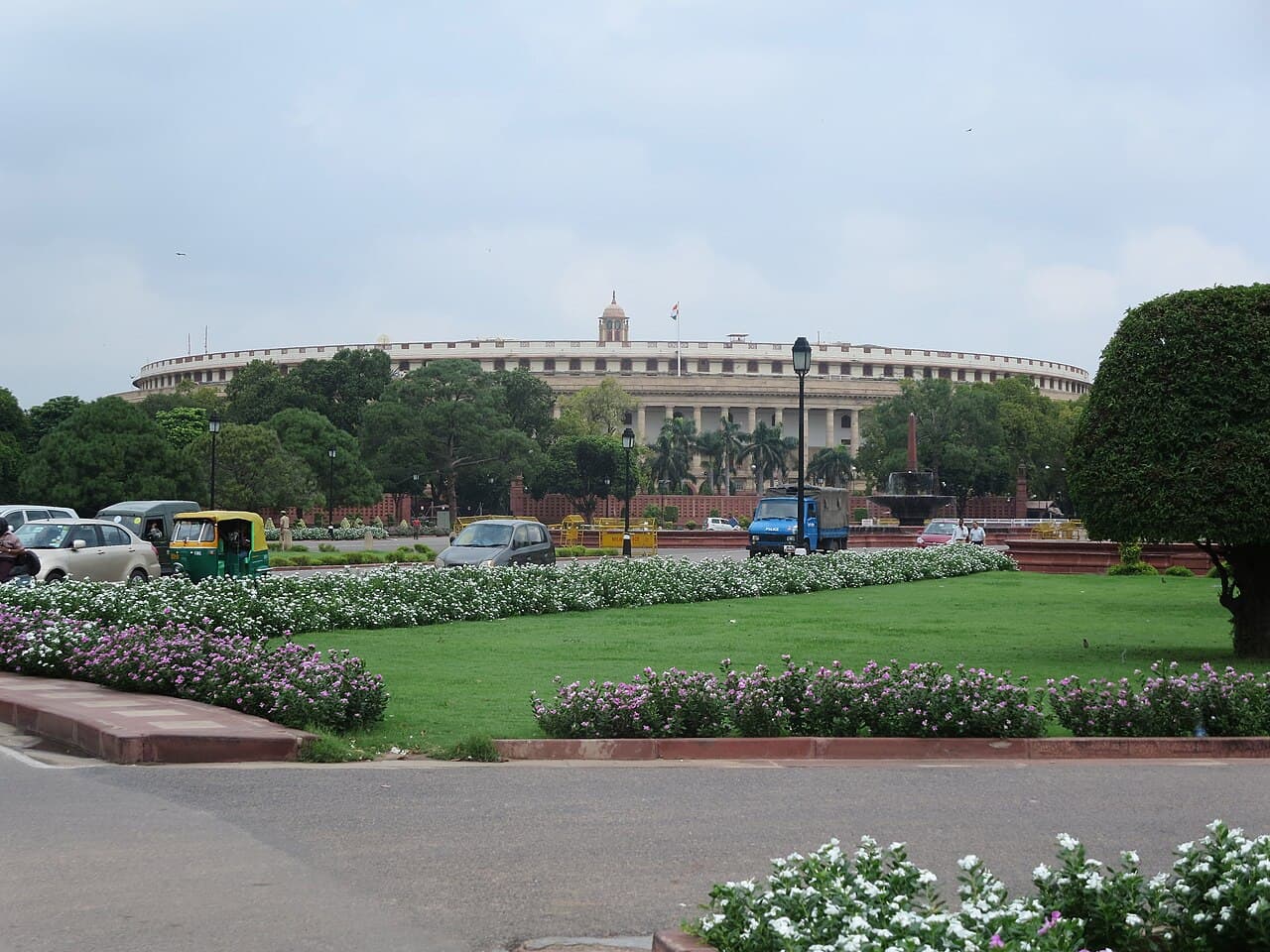
Sansad Bhavan, New Delhi — CJP’s “Chalo Sansad” march on 20 July 2026, the opening day of the Monsoon Session, met tear gas, batons, detentions, and a first official meeting. Photo: Wikimedia Commons.
On Monday, 20 July, tens of thousands tried to walk from Jantar Mantar toward Parliament on the opening day of the Monsoon Session. Delhi Police were on high alert. Metro stations around the protest geography shut for hours. Rapid Action Force units stood at chokepoints. What happened next is disputed in the usual way of Indian street clashes — who pushed first, who threw what, who ordered force — but the visible facts piled up quickly. Police used tear gas and batons. A police vehicle was vandalised and overturned near Janpath. Live reporting by Deccan Herald put injuries among police and protesters above fifty and detentions above a hundred. PTI reported Dipke among those detained near the Reserve Bank of India. Human Rights Watch and Amnesty International condemned what they called excessive force and the suspension of mobile internet at Jantar Mantar, Al Jazeera reported.
From Safdarjung, Wangchuk issued a handwritten statement. Seeing “the brutality with which peacefully protesting youth are being dealt with,” he would continue the fast until youth leaders were allowed to meet parliamentarians at Sansad Bhawan or he was allowed to meet them in hospital. “Hopefully, the government will fix accountability for the Education Minister before that,” he added, as quoted by The Hindu and The Times of India. He also appealed to police and government to let students present grievances, and to youth to hold the line of non-violence.
The same day, a CJP delegation met Union minister JP Nadda and submitted a petition: Wangchuk’s release from what they called detention, Pradhan’s resignation, and Rs 1 crore compensation for families of NEET aspirants who died by suicide. Nadda took the paper and asked for time to consult the government leadership. That meeting is the hinge the mid-July draft could only guess at. Silence had broken. It broke after batons, not before them. That sequence will be remembered as clearly as any later joint press conference.
For the Centre, 20 July was a public-order event on the most sensitive day of a parliamentary calendar. For CJP, it was proof that the state would spill student blood to protect a minister. Both readings now had images. Images are harder to wait out than hashtags.
Medanta, written assurances, and the end of the fast
On 21 July the High Court ordered Wangchuk’s immediate transfer from Safdarjung to Medanta Hospital in Gurugram. Angmo had petitioned alleging illegal detention and seeking a hospital of choice under Articles 19 and 21. A Sunday bench had declined interim interference, holding that the Safdarjung shift was not arbitrary given the earlier monitoring order and his condition. On Tuesday the same court changed course. Solicitor-General Mehta said the Centre had no objection to Medanta. The Hindu reported discharge from Safdarjung at 18:40 and arrival at Medanta at 19:28, under tight security, into ICU 8 under internist Dr Sushila Kataria. Angmo told reporters there had been a “great trust deficit” in the way he was brought to a government ICU. Months later Wangchuk would allege, in a Newslaundry interview, that Safdarjung “fudged” potassium reports to justify keeping him in ICU. That is his claim. It has not been independently adjudicated. It belongs in the same ledger as other contested medical-political facts in this story: recorded, attributed, not declared.
Negotiations continued from the private hospital. Wangchuk later said he extended the fast by two days because talks were on, and that he could have extended it further. Late on 23 July — the 26th day of the fast; some Indian reports date the break to 24 July — he ended it at Medanta. Union ministers JP Nadda and Jitendra Singh were present, as were senior leaders of the Leh Apex Body. His wife was in the room. Visuals showed the ministers helping him take a sip. In a post on X quoted by Indian Express and Al Jazeera, he said 65 MPs from different parties had visited or signed letters urging him to stop. He had broken the fast “after a long negotiation on various conditions and in view of possible violence in the country.” He promised a video on the conditions and asked the country to stay vigilant against violence anywhere.
The conditions, as he and government video later spelled them, were three. The Times of India and Economic Times published the substance of a letter Nadda read out:
The government had “already assured threadbare discussions” in Parliament on paper leaks, accountability in the examination system, and education reforms;
It was “positively considering suitable compensation” for families of students who died by suicide after the NEET leak;
It was “positive on not registering cases” against those who protested peacefully at Jantar Mantar and those who marched toward Parliament on 20 July.
Wangchuk titled his follow-up “End of hunger… Beginning of accountability.” In a later video reported by ThePrint, he denied a “deal” in the bazaar sense. He said he had not demanded Pradhan’s resignation at the hospital table because his priority was a written assurance that students would not face cases. Ministers, he said, first offered only a verbal promise on that point; he refused to relent until it was written. He feared a “Ladakh-like” crackdown in Delhi. That fear is autobiographical, not abstract. He had watched four deaths and then spent 170 days in Jodhpur. A hunger strike that ends to prevent a riot is still a political act. It is also a man who has seen how quickly a crowd can be converted into a security file.
Prime Minister Narendra Modi, shortly before or around the fast-breaking, released a video calling paper leaks a “matter of great pain,” promising a tougher law and fast-track courts, and saying the cabinet would discuss the issue. He did not name Pradhan. After Wangchuk stopped, Modi posted: “I urge Sonam ji to follow doctors’ advice and regain his previous weight as soon as possible.” CJP founder Dipke was “relieved and grateful” and said Wangchuk had “awakened the conscience of an entire nation.” He also said the Jantar Mantar protest would continue until Pradhan resigned. The Guardian’s account of the next day recorded huge demonstrations in Bengaluru, Mumbai, Nagpur, Jaipur, Hyderabad, Chennai, and Kolkata, some with turnouts reported above a lakh, metro closures near the Delhi site, and another internet restriction. Talks with CJP at a “neutral location” produced no resolution on resignation. Nadda said talks would resume.
The Anna Hazare contrast the Opposition had been drawing now cut both ways. Hunger plus a youth meme-party plus a street clash had finally produced ministerial presence, a Prime Ministerial video, and a written scrap of paper. It had not yet produced a resignation. CJP treated that gap as unfinished business, not as betrayal of Wangchuk. Wangchuk treated student safety as the first debit against the moral ledger. Both could be right. The state had moved. It had not surrendered the minister.
25 July: resignation, withdrawal, Joshi
On Saturday, 25 July, Dharmendra Pradhan resigned. In a letter posted on social media and reported by Economic Times and Scroll.in, he said events of the previous ten days caused him “deep distress,” that this was “not a matter of personal prestige,” and that he was stepping down so that students would not get entangled in legal complications and so that “anti-national forces” would not exploit the Jantar Mantar situation. He thanked the Prime Minister, restated commitment to education reform, and framed the resignation as protection of national unity and of students’ futures. The “anti-national forces” clause is the government’s residual narrative: even in retreat, the crowd is potentially contaminated. CJP heard something simpler. “Cockroaches won…democracy won! Jai Hind,” the campaign posted. Dipke told protesters that if you do not get scared, you can take anyone’s resignation.
President Droupadi Murmu accepted the resignation under Article 75(2). On the Prime Minister’s advice she assigned the Education Ministry as additional charge to cabinet minister Pralhad Joshi, who already held Consumer Affairs, Food and Public Distribution, and New and Renewable Energy. Joshi formally assumed the education charge on 26 July, saying he accepted it “with humility.”
Resignation was CJP’s first demand, not its only one. Immediately after Pradhan’s letter, the campaign said it was still waiting on compensation, withdrawal of cases, and action over the 20 July crackdown. A third round of talks followed at the Constitution Club of India with Nadda and Jitendra Singh. Then came a joint press conference. Nadda said all demands had been accepted. CJP spokesperson Saurav Das declared the agitation withdrawn “in good faith and understanding that the agreed-upon terms will be executed within the agreed-upon time period.” Singh interjected “with immediate effect.” Ashutosh Ranka asked protesters to go home. The Hindu, Scroll, and The Guardian recorded the package as reported that evening:
Pradhan’s resignation — done;
Compensation for families of NEET-linked suicides, described as the “maximum possible” under applicable rules, not a locked Rs 1 crore;
FIRs filed by the Centre and NDA-ruled states to be withdrawn; copies of FIRs to be given to CJP; no retaliatory cases against protesters and organisers;
CJP’s five-point examination-reform charter to be examined, with further discussion in about four weeks.
The charter, as summarised by Republic, asked for a new Public Examinations (Transparency, Accountability and Candidates’ Rights) Act to replace the 2024 anti-leak law; structural repair of the National Testing Agency and other exam bodies; enforceable legal rights rather than press-note promises; a National Aspirant Welfare Fund; and permanent parliamentary oversight, including a standing committee and a white paper on twelve years of examination failure. That is a legislative agenda, not a sit-in demand. Agreeing to “consider” it is how governments end crowds without yet rewriting statutes.
The CJP sit-in that began on 20 June lasted about 36 days. Wangchuk’s fast lasted 26. It took five weeks of satire, salt water, a court order, a dawn raid, tear gas, and a cabinet scalp to close the Jantar Mantar chapter. BBC live coverage from the ground that night described celebrations thinning as leaders told people to go home and said they expected to meet the new education minister soon. Rajnath Singh posted that the decision reflected commitment to students, NEET, and reform. Rahul Gandhi called the resignation a step toward reshaping the education system and still demanded an apology and action against those responsible for violence on students. The ruling party credited Pradhan as a reformer of the National Education Policy who had put the country first. All of these statements can be issued in the same hour. That is what a managed landing sounds like.
After the cameras: photos, charter, and CJP’s next campaign
The soup photograph did not stay a private ritual. Wangchuk later said that, in Ladakh, it is customary for government representatives to offer juice or soup once demands are accepted — but that the moment should not be owned by one party. He claimed there was an understanding, with Intelligence Bureau officers present, that pictures from the midnight meeting would not be released until Opposition leaders and, if possible, student faces could be associated, so the break would look like a joint national act rather than a ruling-party benediction. “The ministers had got their own photographers. They pledged to me, they wouldn’t release it. They broke the promise,” he told Rajdeep Sardesai in an India Today interview published around 5–6 August. He said a senior IB officer later came “huffing and puffing” to say the pictures were out. He denied a “midnight deal.” He said the ministers had cropped or omitted the Ladakh leaders in the room. He said the episode left him disillusioned with political leaders across party lines.
These are Wangchuk’s allegations. The government has not, in public reporting, offered a detailed rebuttal of the photo pledge. In Indian politics, the first photograph often is the policy. A minister holding a cup to a faster’s lips is a claim of closure and of patronage. Wangchuk wanted closure without patronage. He got both, stacked in the wrong order.
CJP, meanwhile, tried to remain a movement rather than a one-week meme. After a strategy meeting in Chhatrapati Sambhajinagar it announced a nationwide membership drive and a September “Kya Bolti Public” campaign on unemployment, private-school fees, government schools, and institutional trust — reported by Economic Times. On 11 August, Dipke launched a village-school “Sarpanch Challenge” from 15 August, asking parents to audit electricity, water, toilets, and mid-day meals, as India Today reported. Asia Times described Saurav Das as still in negotiation with the government over the five-point charter. As of 14 August, that charter had been accepted for consideration, not enacted. The four-week follow-up window from 25 July was just coming due. Compensation remained “maximum possible under rules.” FIR withdrawals remained a promise to execute. Joshi remained additional charge, not a full-time education minister appointed to do nothing else.
Wangchuk, in the Newslaundry interview, called himself “a bulldozer, not a car”: once the road is built, you do not want bulldozers running on it. On 20 July’s police action he said accountability was “the least you can do,” while adding that his Ladakhi frame of reference made Delhi’s force look mild by comparison. Hunger strikes, he said, work “not with the leaders… but with the people of the nation who they cannot ignore.” That is the theory the last month tested. The people did not ignore him. The leaders delayed, then photographed, then conceded a minister, then returned to drafts and follow-ups.
Scorecard: what was won, what was deferred
Keep three ledgers open. Propaganda collapses them. Analysis should not.
Delivery ledger (exams). The NEET-UG 2026 paper was leaked, cancelled, and re-held. A Union education minister resigned under youth pressure — a rare event in this government. The Prime Minister promised a tougher anti-leak law and fast-track courts. CJP extracted a written inclination toward compensation and a pledge to discuss reforms in Parliament. It did not extract a locked rupee figure, a new examinations statute, or a rebuilt NTA on a published timetable. “Beginning of accountability” is an accurate slogan only if the next six months produce paper, not only press conferences.
Rights ledger (speech, body, cases). A monitoring order became a dawn removal. A government ICU became a site of alleged isolation. A private hospital became the room where the fast ended. Peaceful protesters were promised no cases; FIRs from 20 July were promised withdrawn. Those promises are only as real as the copies CJP said it would receive and the closures that follow. Preventive-detention law, FCRA cancellation, and the CBI track around SECMOL and HIAL were not erased by soup. NSA revocation ended one order. It did not write a judicial judgment that the detention was unlawful, nor did it close every parallel file.
Security and federal ledger (Ladakh). Four deaths in Leh remain four deaths. The in-principle May–July understanding — UT-level elected body, Article 371 custom model, statehood as aspiration — is the closest the region has come to a written bargain since 2019. As of mid-August the MHA draft of that body’s powers is still unpublished. LAB and KDA have not withdrawn Sixth Schedule or statehood. They have rejected a Territorial Council shortcut. District mobilisation after 15 August is the reminder that minutes are not a constitution.
On the fear maps drawn in mid-July, several boxes ticked. The government avoided a death at Jantar Mantar. It did accept the precedent it feared: a cabinet minister going under satirical youth pressure. It still has not granted Sixth Schedule or statehood. CJP got the scalp and did not get a finished reform law. Wangchuk got written paper and lost control of the photograph. Students got a political victory that will feel hollow if the next NEET cycle leaks again. That is not a cartoon. It is how a large republic lowers the temperature without writing a perfect ending — and how it schedules the next argument.
Conclusion: more than one man
It is tempting to reduce this saga to a personality clash — Sonam Wangchuk versus the Modi government. That is the headline geometry. The substance is larger.
It is about a borderland that welcomed Union Territory status and then discovered it had traded one set of protections for a thinner democratic voice. It is about political promises on the Sixth Schedule that civil society still treats as unpaid debt, now partially refinanced as an unpublished Article 371 draft and a promised UT legislature that does not yet exist on paper. It is about how India uses FCRA and NSA when protest turns disorderly in a sensitive geography — and how release, two days before a Supreme Court hearing, can look like both mercy and litigation management. It is about whether a paper leak that cancels an exam for more than twenty lakh students produces ministerial consequence. In late July, it did. Dharmendra Pradhan resigned. Pralhad Joshi took additional charge. The Cockroach Janta Party went home “in good faith.”
Wangchuk’s life work in education and climate adaptation is not cancelled by controversy; nor do awards immunise anyone from lawful investigation. The government had a duty to keep public order after deaths in Leh; it also has a duty to answer constitutional claims from a tribal frontier without converting every mobiliser into a security exhibit. Students who lost a year, or a life, to a leaked paper deserved accountability that is more than a slogan. For five weeks the state offered slogans, then batons, then a minister’s head, then a charter “to be considered.” Whether that sequence counts as listening depends on whether the charter becomes law, whether compensation reaches families, whether FIRs actually vanish, and whether Ladakh’s draft ever leaves the Home Ministry.
The mid-July question was whether hunger still moved a state that had learned to wait. The August answer is mixed. Hunger, plus a Gen-Z satirical party, plus a march that met tear gas, plus a High Court that would not ignore a falling body, did move a cabinet minister. That is not nothing. It is closer to 2011 than the despairing letters of 1,800 intellectuals had assumed. Then the state tried to own the cup of soup, and the frontier file remained a set of signed minutes without a public draft. Listening, in this context, still does not mean surrendering every demand. It means treating Ladakhi constitutional claims as negotiable politics rather than security contamination. It means treating exam-system failure as a governance emergency rather than a public-relations inconvenience. It means using investigation and courts for alleged financial or criminal wrongdoing without turning the entire toolkit into a single hammer against an inconvenient mobiliser. And it means recognising that hunger strikes are symptoms. The disease is a widening gap between what citizens are asked to trust and what institutions are willing to earn.
Sonam Wangchuk vs the government was always a misleading title if read as a boxing match. It is better read as a stress test: of federal promises after 2019, of preventive-detention norms in peacetime politics, of India’s examination empire, and of whether moral protest still has purchase in an age of hardened executive confidence. Mid-July 2026 made the questions impossible to ignore. Late July proved that a minister can fall. Mid-August 2026 has not finished the test. The mountains of Ladakh are still waiting for a draft. The examination system is still under a cloud that a resignation alone cannot lift. Between those unfinished stories stands the same man, no longer on a salt-water stage, insisting he is a bulldozer rather than a car — and a republic that must now decide whether it will pave the road he cleared, or wait for the next blockade.
This analysis synthesises publicly reported developments as of 14 August 2026. Events around Ladakh’s promised MHA draft, CJP’s four-week follow-up on the examination-reform charter, compensation payments, FIR withdrawals, and any parallel investigative tracks from 2025 may still change. Readers should treat contested allegations — especially financial and incitement claims, hospital-record allegations, and the disputed photo pledge — as claims under investigation or dispute unless and until conclusively adjudicated.
References and further reading
The reporting and explainers below informed this analysis. Links open in a new tab.
Current hunger strike (June–July 2026)
Frontline — ‘Six weeks or death’: Who is Sonam Wangchuk, and why is he fasting?
BBC — Calls grow to end hunger strike as he loses 9.1 kg in 19 days
Outlook — Why is Sonam Wangchuk at the forefront of the CJP protest?
Court order, forced hospitalisation, and Medanta (16–21 July 2026)
The Wire — ‘Life is precious’: court orders government to monitor health
BBC — Activist on hunger strike for 20 days forcibly taken to hospital
The Hindu — Shifted from Safdarjung to Medanta after HC order
20 July Chalo Sansad
End of the fast (23–24 July 2026)
Indian Express — Ends 26-day fast in presence of Union ministers
Al Jazeera — Ends 26-day hunger strike over exam paper leaks
ThePrint — Breaks fast on day 26; CJP continues till Pradhan resigns
ThePrint — Ended fast fearing ‘Ladakh-like’ crackdown; denies deal
Pradhan resignation and CJP withdrawal (25–26 July 2026)
The Guardian — Education minister resigns in victory for Cockroach protests
BBC — Protesters call off strike as education minister resigns
Times of India — How the NEET-UG 2026 leak snowballed into resignation
The Hindu — CJP withdraws; follow-up on five-point charter in four weeks
Economic Times — Pralhad Joshi assumes charge as education minister
August 2026 aftermath
India Today — Wangchuk: ministers broke promise on fast-ending photos
Newslaundry — ‘Breach of trust by govt’: Wangchuk on what comes next
Economic Times — CJP membership drive and ‘Kya Bolti Public’
Asia Times — How India’s ‘Cockroach’ movement grew its wings
September 2025 Leh violence, FCRA, and NSA detention
Release from NSA detention (March 2026)
Indian Express — Centre revokes NSA detention after ~170 days
The Hindu — Both sides must be flexible; linguistic misunderstandings
Ladakh statehood, Sixth Schedule, HPC talks, and 2026 bargain
Mongabay-India — What is the Sixth Schedule? Why Ladakh wants it
Indian Express — Why Centre mulled Article 371-style safeguards
The Hindu — LAB, KDA, Wangchuk to meet Home Ministry (22 May 2026)
The Hindu — Financial decisions will rest with elected leaders
The Hindu — Customised Article 371 model; May 22 minutes signed 3 July
The Wire — MHA and Ladakhi groups reach consensus on key issues
ThePrint — Breakthrough: elected representative body and safeguards
New Indian Express — Groups await MHA draft; no progress after May talks
The News Now — District-level mobilisation planned after Independence Day